Editor’s Note: This content was first published on REDESCover - Edition 112, DDIA's weekly newsletter. Sign up and receive it every Wednesday.
When a 7.4-magnitude earthquake struck western Colombia early on Monday, August 10, 2026, Spanish-language social media users and online networks across Colombia and the United States instantly mobilized. Millions of users tracked the real-time human toll, organized grassroots relief efforts, and debated political responses to the disaster.
Alongside solidarity efforts, social media feeds and encrypted messaging apps were rapidly flooded with misinformation, including AI-generated images, videos taken out of context, weather-manipulation conspiracy theories, and false warnings of aftershocks.
Much like during the recent tragedy in Venezuela, DDIA's researchers followed the conversation on social media in the first 12 hours to make sense of how Latino communities (in the United States and abroad) mobilized after another massive earthquake struck the region. Find below the most important findings as of August 12, 2026.
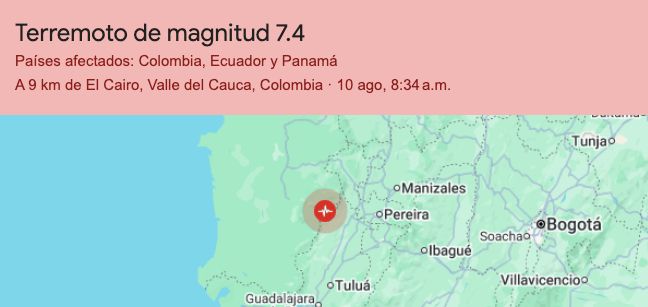
Source: Google Search
Real-Time Updates, Prayer, and Relief Efforts in the First Hour After Colombia Earthquake
Within an hour of the tremor in Colombia, videos depicting collapsing structures, damage to historic churches, and emergency rescue operations flooded feeds across Facebook, X, Instagram, TikTok, Bluesky, and YouTube. Data collected using the social listening tool NewsWhip on these platforms indicates that publications about the earthquake generated millions of interactions across both mainstream Hispanic news outlets and independent Spanish-language creators. The volume of interactions reached the highest levels in the first hours.
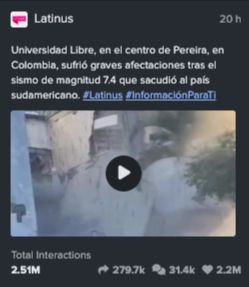
On TikTok, for example, footage showing structural damage at the Universidad Libre in Pereira, published by news portal Latinus, reached over 2.5 million interactions within 24 hours (an average of more than 104,000 likes, shares, and comments per hour).
Many U.S. Latinos with close ties to the most affected areas, including Chocó, Valle del Cauca, and Risaralda, used comment sections on social media posts almost as hotlines. Users exchanged welfare checks, searched for missing relatives, and coordinated relief efforts. But the content of the initial hours fell mostly into one of the following categories:
Spiritual Mobilization: Religious institutions and leaders such as Delaware-based Catholic site BibliaTodo and Honduran pastor Guillermo Maldonado mobilizing hundreds of thousands of interactions through calls for prayer.
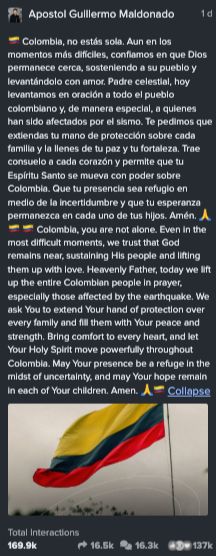
Source: NewsWhip
Humanitarian Support: Influencers with ties to Latino diaspora communities amplified official and grassroots relief. Progressive creator Carlos Eduardo Espina and El Salvador’s right-leaning President Nayib Bukele, for example, highlighted emergency assistance and received visible support from the community.
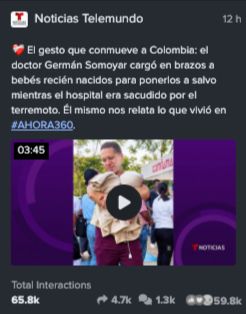
Source: NewsWhip
The Political Conversation
As the hours passed, the viral Spanish-language conversation on social media channels mostly shifted into political debates and discussions about local emergency measures.
National and Local Responses, led by Colombian President Abelardo de la Espriella, drove high levels of engagement in Spanish. His administration declared a state of national disaster, and Espriella suspended his agenda to oversee operations in the Pacific region. In Cali, where over 20 buildings collapsed, Mayor Alejandro Eder enacted a citywide curfew to prevent looting, which generated some criticism.
International Aid came right after, with military deployments and international support receiving a positive online response. Statements from U.S. Secretary of State Marco Rubio sparked some debate about Colombia's long-term recovery capacity.
Disinformation Surge: AI Visuals, Conspiracies, and Fake Warnings
Between August 10 and 11, Spanish-speaking fact-checkers debunked emerging falsehoods that DDIA noted fell into three buckets:
Manipulated Media and AI: A widely shared photo claiming Cali’s Monumento a la Resistencia had collapsed, for example, was proven to be AI-generated. Out-of-context video clips, such as footage purportedly showing construction workers clinging to steel bars and a video falsely labeled as a school during the quake also surged.
Conspiracy Theories: Viral claims attempted to link the earthquake to HAARP, falsely alleging this high-power atmospheric research facility based in Alaska could have been used for weather manipulation.
False Aftershocks: Finally, DDIA researchers and fact-checkers detected misleading posts circulating online with false time predictions for impending aftershocks. Seismologists emphasize that while aftershocks occur, exact times and magnitudes cannot be predicted in advance.
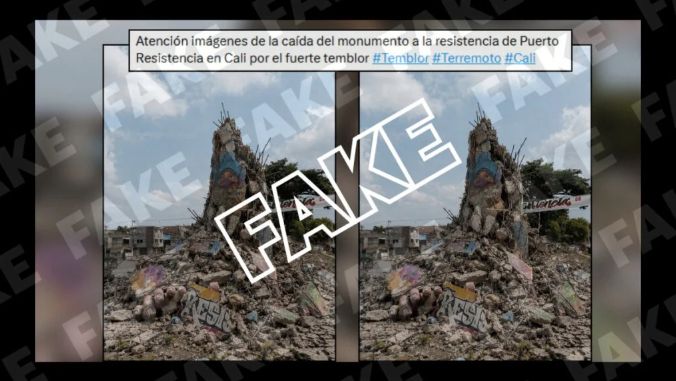
Source: Newtral (Spain)
WhatsApp and Telegram
Public WhatsApp and Telegram groups served as ground-zero crisis hubs for Latinos all over the world, but particularly around the epicenter of the earthquake, in San José del Palmar. Key messaging trends analyzed via data DDIA collected using Open Measures indicate that the apps were used for the following different purposes in the first 24 hours after the quake:
Tracking Damage to Infrastructure: WhatsApp and Telegram users documented, for example, severe damage at Manizales’ Cathedral Basílica Metropolitana, the evacuation of Cali’s ValleSalud Clinic, and the operational shutdown of seven regional airports.
Sharing Resources: App users also shared links to search portals such as colombiatebusca.com alongside reports of $15.5 million in U.S. assistance and rescue clips, including 16 passengers trapped in Pereira’s Megacable.
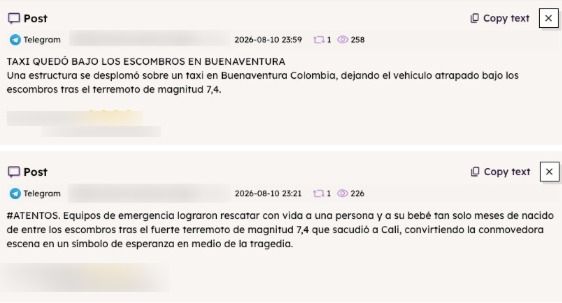
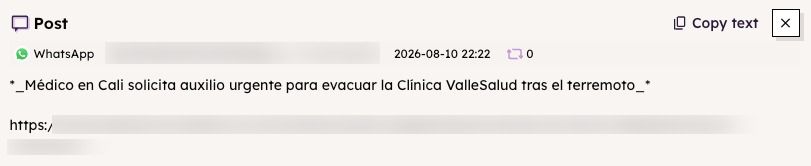
DDIA researchers also observed what could be automated bot activity flooding WhatsApp and Telegram chats.
Duplicate news headlines with tracking links about the disaster in Colombia were copied up to 16 times across groups to farm ad traffic. Complex disinformation campaigns, like the ones seen on open social media, also pushed claims of weather control, Russian submarine detonations, and political shifts as a potential reason for the quake.
Political Polarization Capitalized on Post-Disaster Chaos and Sparked a Hoax
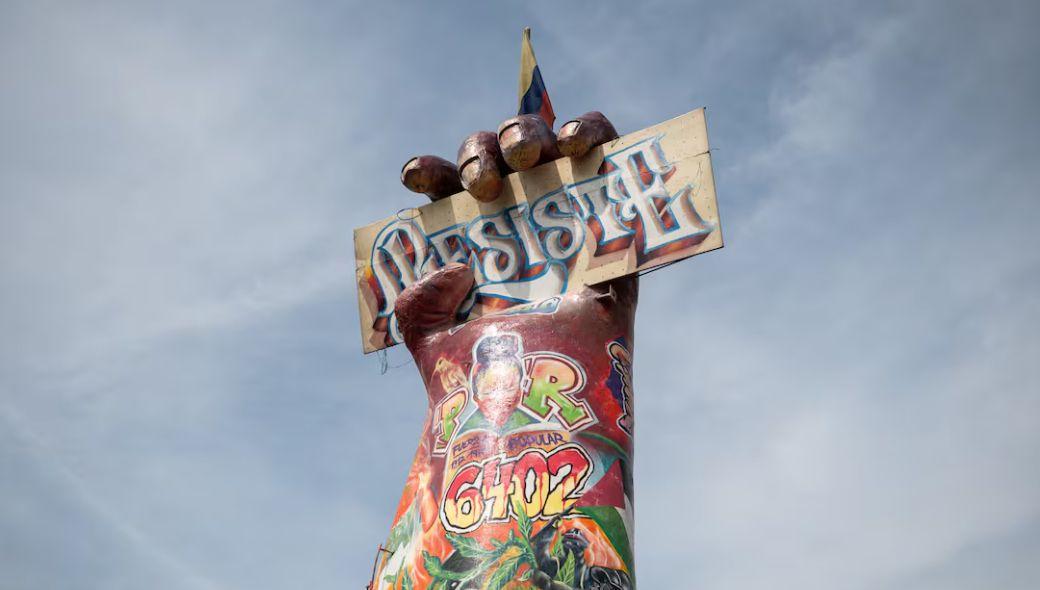
Standing 9.5 meters tall in Cali's Puerto Rellena sector (renamed Puerto Resistencia), the "Monumento a la Resistencia" features a massive left forearm and fist clutching a plaque inscribed with a single word: "Resiste." Built during the 2021 National Strike (Paro Nacional) in Colombia, the monument serves as a prominent landmark honoring social mobilization and the victims of police violence.
In the chaotic aftermath of the recent earthquake in Colombia, a viral hoax claimed this central symbol of the country's leftist movement had been destroyed. The image was fake. The monument remains standing.
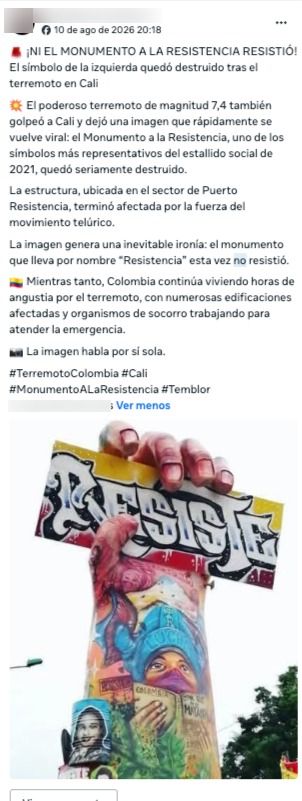
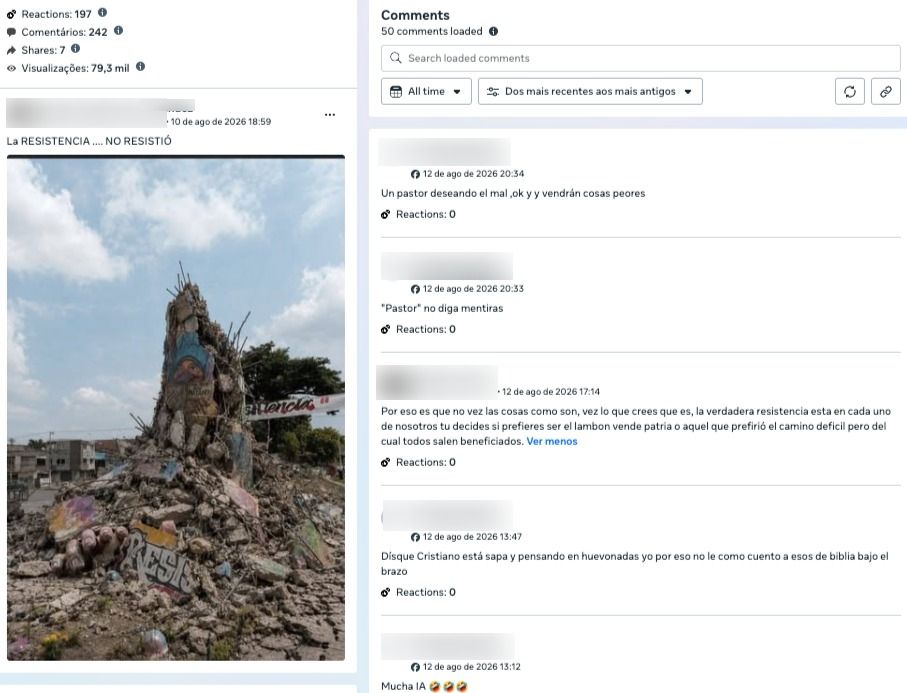
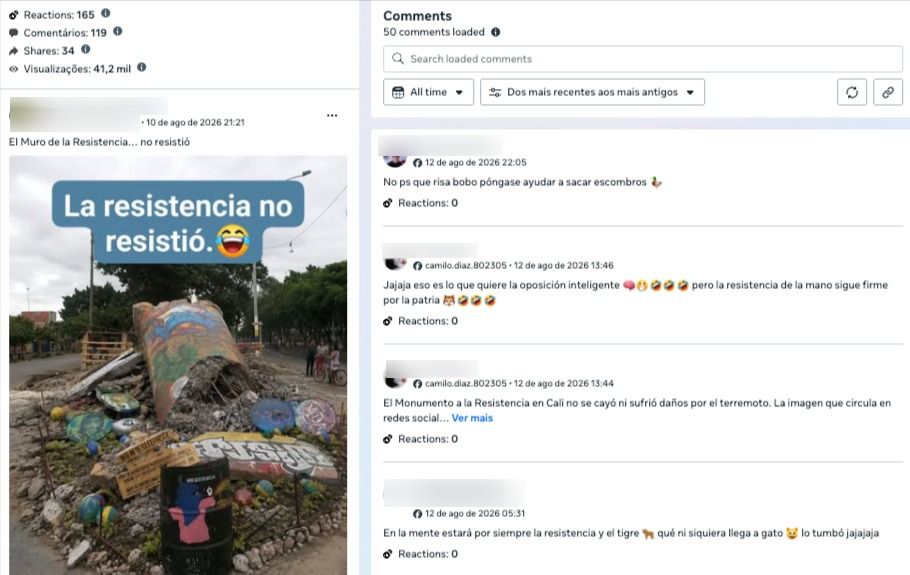
But an analysis of dozens of Facebook and Instagram posts reveals that the false narrative was heavily driven by Colombia's political right, particularly critics of former President Gustavo Petro, in the first hours after the quake.
Following the recent electoral victory of right-wing leader Abelardo de la Espriella, part of a broader conservative wave sweeping the Americas, opponents of the former administration seized on the fabricated image to push a narrative that the Colombian left had collapsed "for good."
Yet, user interactions tell a different story. Comments left across several publications reviewed by DDIA show a swift public backlash. Users actively debunked the image, shared fact-checks, and called out political actors for exploiting human suffering for partisan gain. Some of these images are depicted below:
Methodology: DDIA collected and analyzed social media and messaging apps raw data using NewsWhip and Open Measures. The data collection used to back this article and REDESCover newsletter took place between Aug 4-12, 2026. All searches were conducted in Spanish and English.