Foundational Context
From 2016 to 2026, leaders from across the ideological spectrum in the United States and Latin America have doubled down on intentionally and consistently spreading false and misleading claims of election fraud leading up to key votes. They do this to sow distrust in a way that allows them to question results if they lose.
Misinformation is predictable because it often comprises a larger “umbrella” story that gets repeated and rarely changes, and a series of specific claims that are used to prop up that story. Unsurprisingly, the false “elections and voting” meta-narrative is that “elections are fraudulent and can’t be trusted.”
The specific claims that underpin this larger narrative usually fall into four key buckets. These include outright lies and misleading information about: 1) the electoral system, 2) the process of voting, 3) the voters themselves, and 4) the candidates. Focusing on the meta-narrative and understanding that lies get recycled makes getting ahead of these online harms easier and more sustainable.
Need to Know for 2026
In the 2026 U.S. midterm elections, as in 2024 and 2020 presidential elections before that, DDIA expects the following 10 claims will be used to sow distrust in the midterm elections. Keep in mind many of these claims will have grains of truth that will get decontextualized or manipulated to push an agenda. You can expect to see or might have already seen similar claims emerging in this year’s elections in Colombia, Peru, and Brazil.
Claims that non-citizens are voting, which will be used to justify real or fabricated appearances by ICE at polling stations
Claims that dead people are voting, with one-off stories telling of specific cases that may have been true but that could never have swayed an election
Claims that delays at polling places or one-off hiccups on the day of elections are proof of widespread fraud
False claims of ballot switching, voting machines not working, or voting infrastructure being hacked
Claims that elites and the deep state are rigging elections, this year counting on Venezuela-related claims of interference in U.S. elections
False accusations targeted at political parties and electoral authorities
False or misleading information about who has the right to vote
False or misleading information about the documentation someone should use to vote
Claims that surveys / polls are manipulated
Made-up statements attributed to electoral candidates, or candidates’ comments being taken out of context
Beyond the claims, we expect what we are now calling “the Global Election Fraud Echo Chamber” to be more prominent than ever. Every election cycle we see that a claim of election fraud in one city or country is immediately weaponized by actors in cities and countries across Latin America and Spanish-speaking Europe to reinforce a global narrative that, most prominently, “party A or B is stealing democracy.”
In Q1 of 2026, we have already seen claims of election fraud emerging in Colombia and Peru being echoed and amplified by U.S. stakeholders, Brazilian stakeholders and Argentinian stakeholders. Expect the echo chamber to become louder and more well coordinated as we near the U.S. midterms and Brazilian presidential elections in October and November.
Narratives and Claims Spreading So Far Among U.S. Spanish-Speakers in 2026
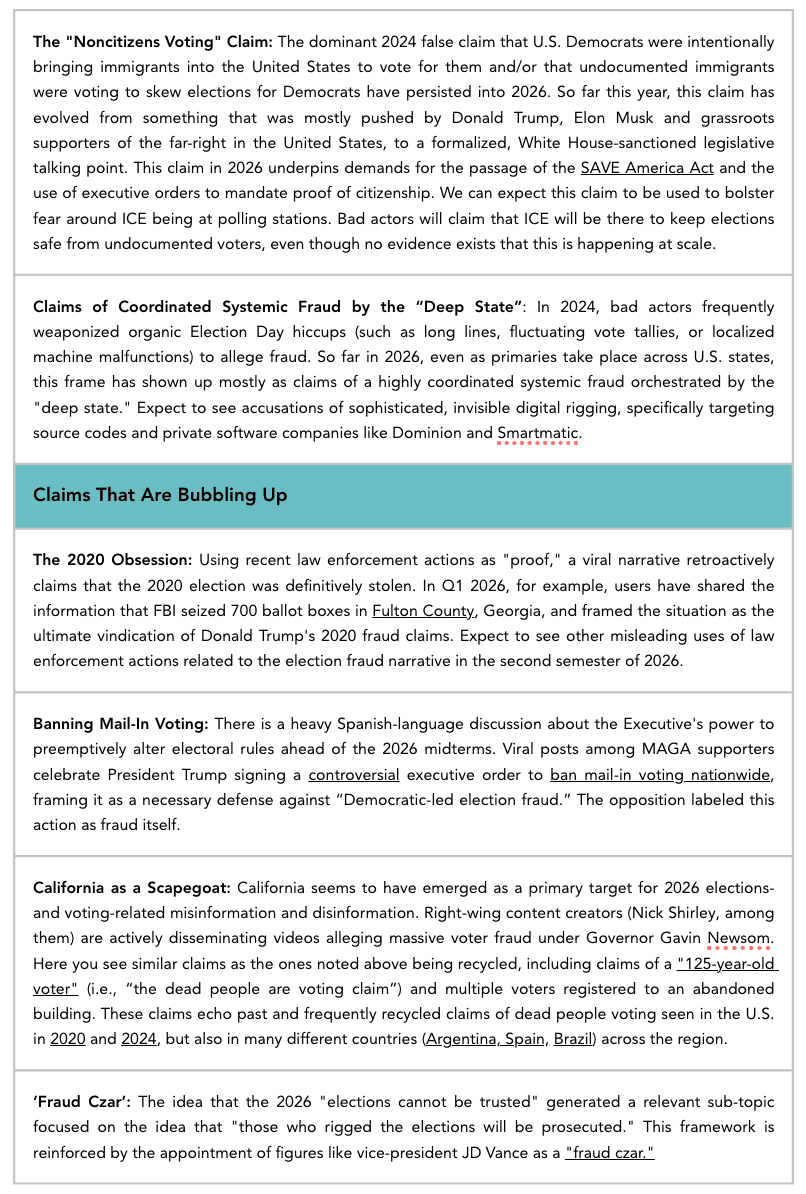
Where and How Election Fraud Claims Are Spreading
The spread of election-related false and misleading claims in the first half of 2026 follows a clear, multi-platform pathway shaped by both political elites and digital ecosystems. The majority of U.S.-based election-fraud related conversations originate on Truth Social, where statements from Donald Trump and his close allies serve as the initial trigger. From there, the content migrates to more mainstream platforms, gaining broader visibility and traction – with Democrats engaging with it.
X (formerly Twitter) plays a central role in amplification, much like it did in 2024. It functions as the primary arena for fast-moving, “breaking news”-style misinformation and disinformation, where claims, such as alleged ballot box seizures in Fulton County or accusations targeting California’s voter rolls, are rapidly disseminated and debated. Politicians and political commentators commonly tag international allies on X to build a global “consensus of fraud."
YouTube, in turn, serves a different but complementary function. The platform is widely used for long-form Spanish-language content that “connects and expands” on conspiracy theories. Videos often attempt to weave together multiple narratives, offering detailed “explanations” that link unrelated topics, such as foreign conflicts (Maduro's arrest, the war in Gaza) and domestic elections (Mandami's election in NYC), into a single storyline. Long-form debate shows and "expert" interviews are used to present complex, pseudo-technical "audits" of election data.
TikTok is being used for mobilization against events some people perceive as being fraudulent and, consequently, generated outrage. Short, high-impact clips of street protests, clashes with police, and leaked hidden-camera videos dominate the platform, designed to trigger immediate emotional outrage.
The Borderlessness of Election Fraud Narratives and How the Movements Connect
All research work done by DDIA has shown that misinformation and disinformation are often culturally adjusted to fit into a national reality. The list below brings some concrete examples that resonated abroad and among diaspora communities in the U.S. between January and May 2026.
In/from Mexico, some supporters of Claudia Sheinbaum and the Morena party amplified claims that previous elections involving former president Andrés Manuel López Obrador were fraudulent. Opposition members shared publications amplifying the U.S. Department of Justice accusations that the Sinaloa Cartel actively stole ballots in 2021 to secure the election of Morena’s Senator Rubén Rocha Moya, weaponizing international indictments to delegitimize the ruling party's electoral history. Both cases feed into broader regional patterns of anticipatory distrust in the power of voting.
In/from Colombia, claims questioning electoral integrity have gone mainstream, like in the United States. Leading up to the June 21 presidential elections, current President Gustavo Petro repeatedly “warned” of a “100% risk of fraud” in this year's election, pointing to alleged (and unproven) manipulation through software systems and private contractors like Thomas Greg & Sons. He also amplified claims that leaving blank spaces on official E-14 voting forms could enable post-election tampering, despite electoral authorities stating there is no evidence such vulnerabilities exist. Following Abelardo de La Espriella’s victory, Petro continued to question the results of the election, resulting in de La Espriella suspending the transition process and claiming Petro has launched a plan to “cling to power,” with calls for Colombia’s armed forces to “honor their oath to protect the constitution and democracy and to disobey any orders from Petro to the contrary.”
In/from Peru, the narrative of a stolen election remained persistent and forward-looking. Leading up to the June 7 elections, Keiko Fujimori and Rafael López Aliaga continued to claim that the 2021 presidential election was fraudulent. Following the April elections, a dominant narrative asserted that the ONPE (Peru's electoral body) engineered digital fraud (not proven) to eliminate Aliaga from the second round. The claims centered on a technicality regarding "actas 900,000" (rural voting records), which were framed as fabricated digital votes.
AI-Driven Content and Manipulation
In 2026, the use of artificial intelligence in the spread of political misinformation and disinformation has entered a more aggressive and explicit phase, one that moves beyond manipulation into outright provocation.
Unlike in 2024, when AI-generated audio voice clones popped up in isolated moments, the current cycle is marked by deep uncertainty by voters that everything they’re seeing online could be AI-generated, per DDIA’s own qualitative research, as well as by the actual circulation of highly provocative, deliberately inflammatory pieces of synthetic media designed to shock, spread rapidly, and reinforce divisive narratives.
In mid-January, for example, Attorney General Ken Paxton, who was running for U.S. Senate, shared an AI-generated video showing his Republican primary opponent Sen. John Cornyn dancing with Democratic U.S. Rep. Jasmine Crockett of Dallas to suggest he was too close to the “liberal lunatics.”
These AI-generated visual fabrications are also being pushed by powerful people with large followings to undermine past, present, and future political opponents. Prominent cases between January and May included an AI-generated video disseminated by the White House depicting former President Barack Obama and Michelle Obama as apes. Before that, President Trump posted an AI-generated video of House Minority Leader Hakeem Jeffries wearing a mustache and a sombrero while mariachi music played in the background.
Equally significant is how these materials are handled. President Donald Trump and many of his supporters either embrace the absurdity and call it comedy, or try to gaslight the public into thinking they had nothing to do with it. The impact is cumulative. Bad actors are effectively lowering the threshold for what is considered acceptable in public discourse. Over time, this dynamic desensitizes audiences, allowing increasingly extreme and fabricated content to circulate as part of the mainstream political conversation.
On WhatsApp
In the first five months of 2026, DDIA identified almost 300 unique Spanish-language WhatsApp messages (an average of two per day) circulating in public groups discussing election integrity. Data extracted from Palver indicated this content potentially reached more than 20,000 users, underscoring the scale of political discourse within encrypted Latino networks.
A detailed analysis of this content once again reaffirms previous DDIA findings that show U.S. Latinos are engaged with U.S. domestic politics as well as with political crises in Latin America – and often connect one to the other.
At the core of this activity is a high-intensity, false transnational narrative linking South American electoral systems to U.S. voting infrastructure. In the analyzed period, WhatsApp users repeatedly circulated claims that election technologies allegedly tied to former Venezuelan leader Hugo Chávez were used to manipulate the 2020 U.S. election. These claims frequently target companies such as Dominion Voting Systems and Smartmatic, portraying them as compromised or politically controlled. However, these allegations have been repeatedly and definitively debunked by election officials, cybersecurity authorities, and courts in the U.S. and Latin America. There is no evidence of widespread fraud or vote manipulation in the U.S. in 2020. Notably, Smartmatic’s technology was used only in a limited jurisdiction and played no role in the battleground states that determined the election outcome that year.
Despite this, in the first five months of 2026, some WhatsApp users speculated that the arrest of Venezuelan leader Nicolás Maduro in New York could expose hidden evidence of U.S. electoral fraud, an idea that mirrors broader conspiracy narratives circulating globally but has no root in facts and that Donald Trump will undoubtedly harness to sow further doubt.
In WhatsApp, users seem to be actively synthesizing personal and regional experiences, particularly from countries like Venezuela and Colombia, to validate skepticism toward U.S. elections. The moment Latinos see that politicians from opposing sides or ideological leanings, like Petro and Trump, for example, have similar arguments to doubt the election process, many conclude voting is rigged. This creates a hybrid narrative environment where local political distrust is reinforced by perceived regional shared grievance.
How to Be Ready for November 2026
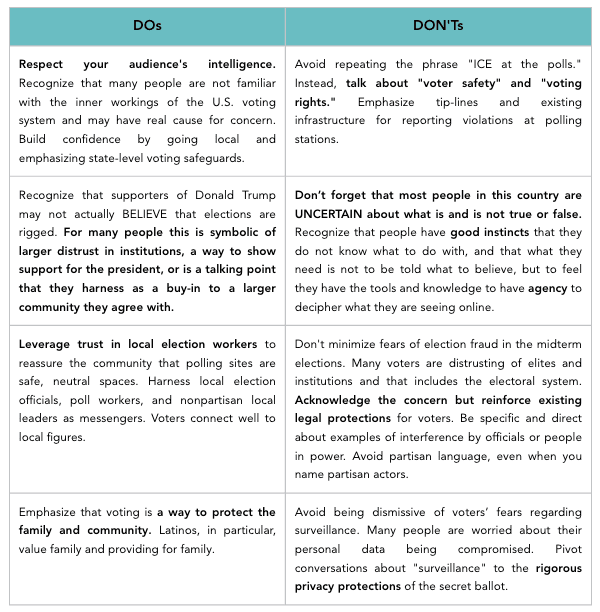
Conclusion:
Since Q4 2024, when DDIA published its last election-centered snapshot, Spanish-language election fraud discourse in the U.S. has again picked up steam, and is now pushed fervently by the Trump White House and President Donald Trump himself. Official discourse again reflects the now-frequently recycled larger false meta-narrative that elections are fraudulent and can’t be trusted. Again preparing for the occasion in which his party may lose, the president and his supporters are claiming the 2026 midterms are vulnerable to fraud, with the updated solutions being that redistricting (gerrymandering) and proposed actual laws banning mail-in ballots are the necessary responses.
When looking only at the Spanish-speaking voters another narrative/message seems to be consistent: voting is risky, voting is unsafe, and nothing will change regardless. DDIA's researchers interpret this as a deliberate suppression strategy, one now reinforced from both ends of the political spectrum, each delegitimizing the process through its own terms.
Finally, it is clear that AI-generated content is accelerating the most extreme end of this ecosystem. Dehumanizing imagery has moved rapidly from fringe spaces into mainstream digital circulation, widening societal fractures that electoral disinformation is designed to exploit. This snapshot aims to dive into all these conclusions and help different stakeholders better prepare for the electoral year ahead of us.
Methodology:
Queries: DDIA's “election integrity” keyword database
Period: 1/1/2026-5/20/2026
Language: Spanish
Geolocation: All
Tools used: NewsWhip, Palver and Gemini