Maduro Arrested, Power Shifts, and Messaging Apps Explode
In a high-stakes pre-dawn raid, U.S. elite special forces captured Venezuelan leader Nicolás Maduro and his wife, Cilia Flores, designating them as narcoterrorists and supposedly bringing an end to the controversial regime that has governed the country for years. The mission, dubbed “Operation Absolute Resolve,” represents the most significant U.S. military intervention in Latin America in recent history and has already sparked multiple lines of debate – in English and Spanish.
Although Venezuelan Vice President Delcy Rodríguez has been sworn in, President Donald Trump said during a press conference in the morning of January 3 that a “group,” potentially led by U.S. Secretary of State Marco Rubio and U.S. Secretary of War Pete Hegseth, will oversee the country’s transition, with a focus, seemingly in large part, on restoring Venezuela’s oil infrastructure.
President Trump also stated that Venezuelan opposition leader María Corina Machado is not likely to be the next leader of Venezuela, claiming she does not have sufficient “internal support” despite her Nobel Peace Prize and her success in unifying a strong opposition movement.
Using Palver, a social listening tool that offers us insights into public WhatsApp and Telegram channels, researchers at DDIA have been, and will continue, closely monitoring how English- and Spanish-speaking audiences are reacting to the news about Venezuela.
Though we generally focus our attention on 3,300 Spanish-dominant groups that comprise at least 30% U.S.-based phone numbers, for this analysis, we broadened the scope of the research to include the entire universe captured by Palver in both English and Spanish (~100,000 public groups worldwide).
This article will be updated (from the top), with a clear timestamp disclaimer.
ANALYSIS - January 3, 2026 - 10:00 a.m. to 1:00 p.m. ET
Between 10:00 a.m. and 1:00 p.m. ET on Saturday, January 3, 2026, at least 3,000 unique messages in Spanish and 2,000 in English were shared across 1,101 public WhatsApp and Telegram channels the Digital Democracy Institute of the Americas (DDIA) monitors. An estimated 51 million Spanish-speakers and 183 million English-speakers may have been exposed to at least one of these pieces of content.
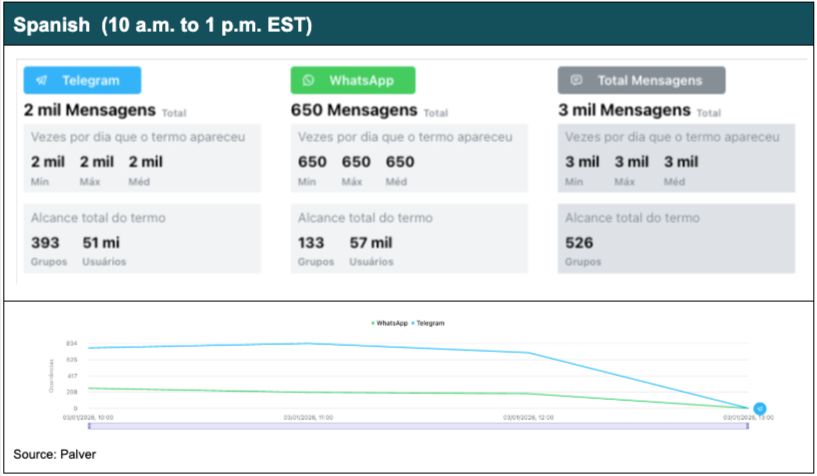
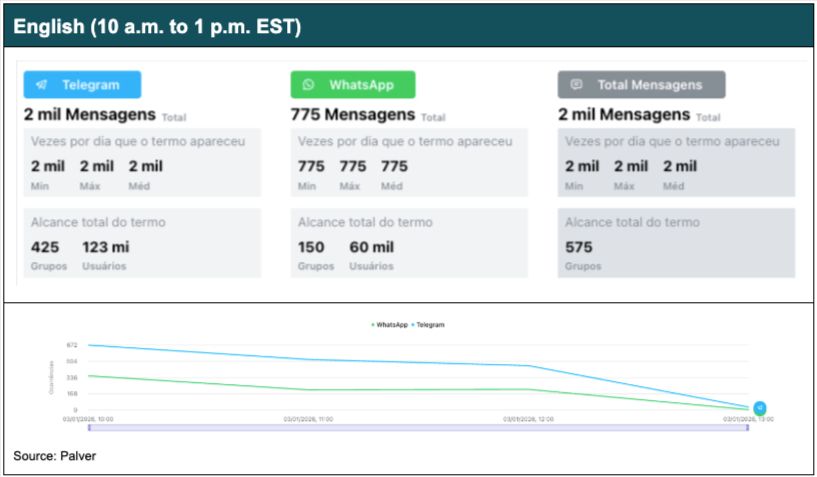
In this period, Trump offered a one-hour long press conference regarding the operation in Venezuela. Rubio, Hegseth, and General Dan Caine also spoke.
On WhatsApp and Telegram Spanish-speaking groups, the key narratives were the following:
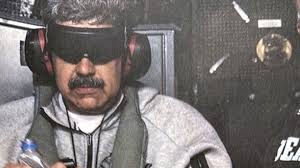
The Tactical Apprehension and Transfer of Nicolás Maduro. This primary narrative detected by our researchers in Spanish focused on the physical capture of Nicolás Maduro as a successful and meticulous move – something that only the U.S. could have pulled off (language President Donald Trump offered during his press conference). The messages in this universe detailed Maduro’s detention aboard the USS Iwo Jima and amplified a photo (posted by President Trump) where Maduro appears "handcuffed and blindfolded," while being transferred to New York for prosecution.
U.S. Governance and Economic "Transition" in Venezuela. Spanish-speakers also used WhatsApp and Telegram to amplify specific quotes given by Trump regarding the future of Venezuela under U.S. administration. Most people seemed to share messages comprising news links noting the U.S. will govern the country until a "legal transition" is achieved, with a strong focus on resuming oil production and "generating money" to make Venezuelans "very rich." Not many are venturing yet into what that could mean in the medium term.
Sovereignty, Resistance, and Imperialist Aggression. This third narrative is the smallest and represented the counter-response, primarily from pro-Maduro voices or anti-interventionist groups. It frames the U.S. actions as "Yankee imperialist aggression" and a violation of sovereignty.
On Telegram only, Colombian President Gustavo Petro and Brazilian President Lula da Silva are framed as Latin American leaders of a U.S. opposition movement that is portraying U.S. actions as illegal activities or as an "unacceptable" violation of sovereignty (see links below). A significant sub-theme involves Trump's direct threats toward Petro regarding (an unverified) cocaine production under his order.
On WhatsApp and Telegram English-speaking groups, the key narratives were the following:
U.S. Military Precision and the Capture of a "Fortress." This narrative focused on the technical and tactical success of the U.S. operation to apprehend Nicolás Maduro. Messages described the raid in cinematic detail, highlighting the use of "massive blowtorches" and the breach of a "fortress-like" residence equipped with steel doors. The tone was celebratory of U.S. leadership and military professionalism, often framing the event as a definitive end to the regime.
On Telegram only: Viral messages explicitly discussed Donald Trump’s mention of the replacement of the historic Monroe Doctrine with a new "Donroe Doctrine," something noted as signaling absolute American supremacy in the Western Hemisphere and a commitment to preventing "authoritarian ideologies" from returning. References to the new doctrine appeared in relation to conversations about the United States "running the country" of Venezuela during a transition period to ensure a "safe, proper, and judicious" transfer of power.
The "Oil Robbery" and Economic Exploitation. A counter-narrative suggests that the U.S. intervention is a thinly veiled mission to seize Venezuela’s oil wealth. These posts claim that President Trump has already designated American companies to manage the country's petroleum reserves, something he affirmed. This theme characterizes the operation as "theft" and "robbery," dismissing humanitarian or democratic justifications. It is worth noting, President Donald Trump did much not cite human rights or democracy in his press conference address.
ANALYSIS - January 3, 2026 - 12:00 a.m. to 10:00 a.m. ET
Between midnight and 10:00 a.m. ET on Saturday, January 3, 2026, at least 13,000 unique messages mentioning Venezuela were shared across public WhatsApp and Telegram channels. An estimated 124 million Spanish-speakers and 176 million English-speakers may have been exposed to at least one of these pieces of content.
In the early hours of January 3, overall sentiment in both languages was largely favorable to the U.S. action in Venezuela across these app discussions, although chavismo found notable support within Spanish-language Telegram channels. See details in the table below.
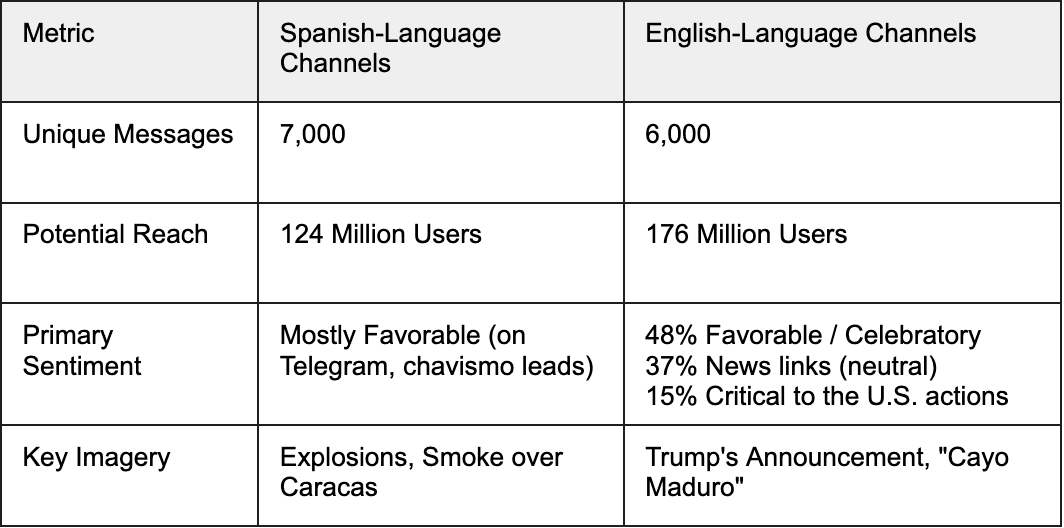
Our analysis of over 13,000 unique messages detected by Palver across WhatsApp and Telegram reveals a set of narratives equally spreading in both languages:
The "Liberation" Narrative: Primarily dominant in English-speaking circles and among the Venezuelan opposition, this view celebrated the capture as a "new dawn." High-engagement posts featured triumphalist language, with many users circulating a tweet from Trump as evidence of a decisive end to the regime.
The "Imperialist Aggression" Narrative: In stark contrast, official Venezuelan government communiqués and state-aligned groups characterize the U.S. move as a "barbaric" and "criminal" invasion. These messages alleged that the U.S. has targeted civilian areas and is motivated solely by a desire to seize Venezuela's vast oil and mineral resources.
The Defensive Mobilization: Acting leaders within the Venezuelan government, including Vice President Delcy Rodríguez and Defense Minister Vladimir Padrino López, declared a "State of External Commotion." They called for an "armed struggle" and a "civic-military-police fusion" to resist what they termed an illegal occupation.
The Vacuum of Power
As Maduro is reportedly being flown to New York to face the "full wrath of American justice," Caracas remains in a state of high tension. Power outages have hit parts of the capital, and the FAA has prohibited American aircraft from entering Venezuelan airspace.
While the U.S. evaluates its "next steps," the immediate future of Venezuela's governance is uncertain. Vice President Delcy Rodríguez demanded "proof of life" for the captured Maduro, even as some military factions reportedly urge soldiers to desert and "restore democracy."
Here is what Latin American leaders posted during this time frame: