AI, Data Centers, and U.S. Latino Voters
October 22, 2026
This poll was conducted in partnership with YouGov.
Findings outlined in this report comprise of phase 1 of this data launch.
Download
CONTEXT
Artificial intelligence (AI) has quickly taken over headlines, debates, and discussions as voters head to the polls for Nov. 3 midterm elections in the United States. Current candidates and future electeds are already or will soon be formulating their positions on AI and data center policies, even as the rapid evolution of AI technologies already affects jobs, household costs, information environments, and, potentially, political participation.
In an effort to understand how U.S. Latino voters perceive AI and data centers, the Digital Democracy Institute of the Americas (DDIA) partnered with YouGov to explore how U.S. Latino registered voters use and trust AI, weigh the local benefits and costs of data centers, and think about AI and data centers’ broader impact on society and the 2026 elections, among other topics.
The findings outlined in this report offer insights into the following key questions:
Where are U.S. Latino voters going for media and information?
How do Latinos use AI and which tools do they use most?
Which stakeholders do Latino voters trust most to keep the public safe as AI develops?
How do respondents evaluate the local and national tradeoffs associated with data centers?
Where to Latinos fall in support or opposition to data-center construction in one’s own community compared with another state?
Which political party is seen as better able to manage AI regulation, technological innovation, and data-center regulation?
Which policy proposals attract broad support, and where do views divide by party, ideology, income, age, language, geography, and AI use?
Key Takeaways
U.S. Latino voters get much of their daily media from social media platforms, and younger Latinos are increasingly turning to AI for media consumption.
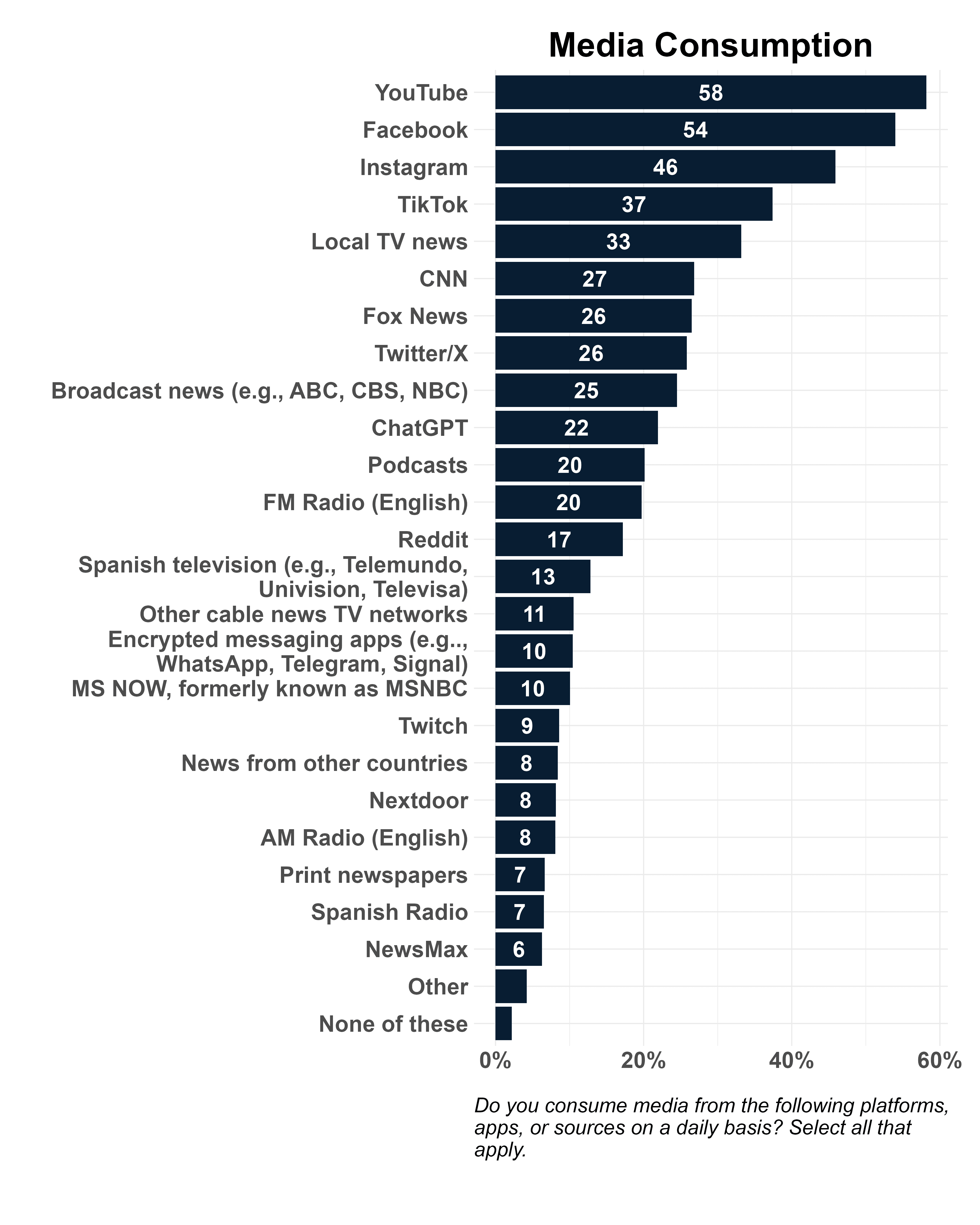
More than half of Latinos polled use YouTube (58 percent) and Facebook (54 percent) as daily media sources, and nearly half use Instagram (46 percent). Local TV is the most popular traditional source (33 percent).
About one in five Latinos use ChatGPT for consumption of daily media (22 percent).
About a third of Latino voters under 30 said they use ChatGPT for media on a daily basis (35 percent).
Latino voters are embracing AI tools, but worries about the risks remain high.
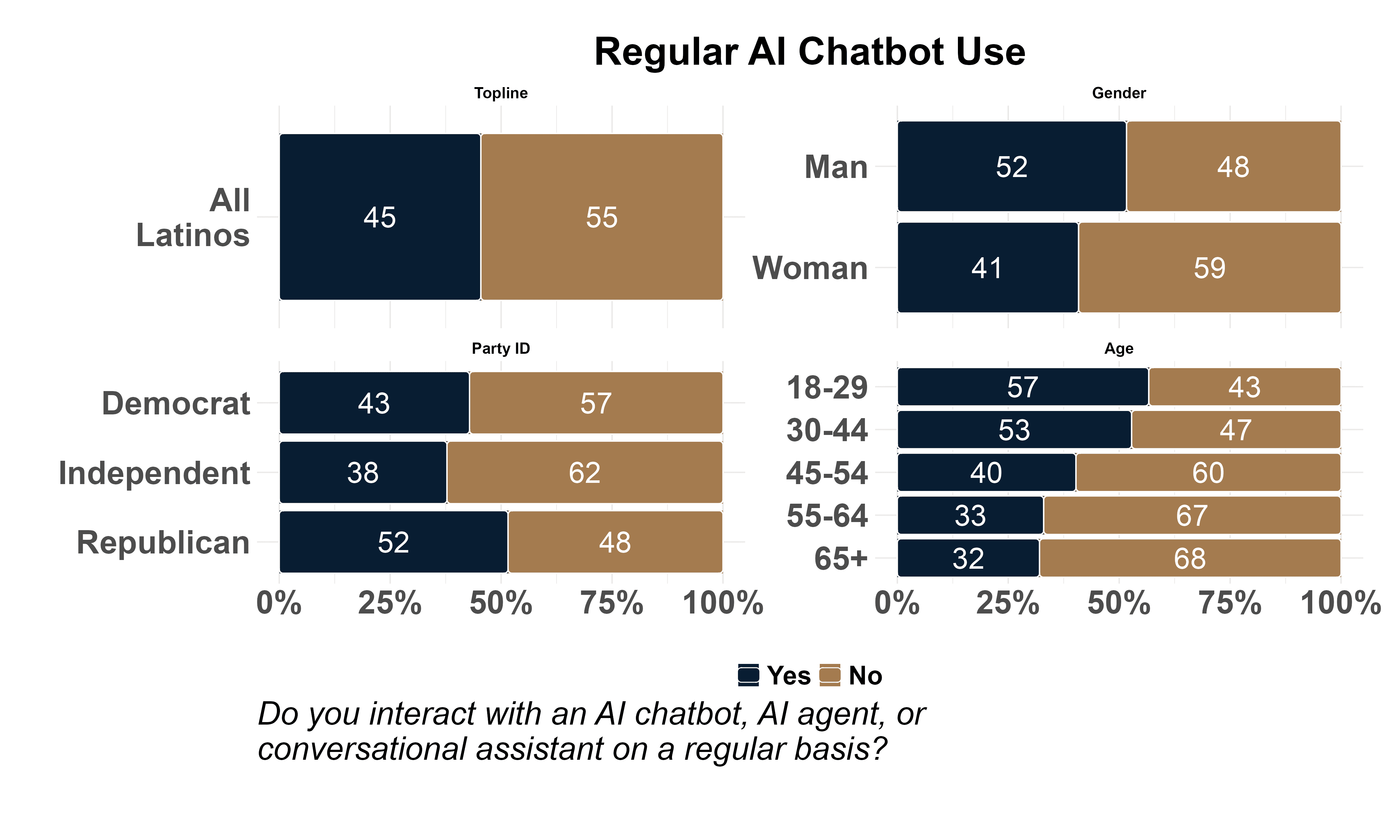
Nearly half of Latino voters use AI on a regular basis (45 percent). This figure was 20 percent in polling DDIA conducted in September of 2024, and 15 percent in March of 2024.
ChatGPT is the most widely used tool (54 percent use it regularly), followed by Gemini (43 percent). Only 15 percent responded they use Claude.
About twice as many Latino voters are worried about AI as are excited about it (38 percent vs. 20 percent).
More than four in five (82 percent) expect developments in AI to affect their lives in some way.
57 percent of Latino voters would not be comfortable using an AI chatbot to help them decide how to vote.
Latino voters want firmer rules for AI companies.
78 percent of Latinos polled agree there is a pressing need for stricter oversight of AI, including majorities of Democrats (83 percent), Independents (73 percent), and Republicans (72 percent).
About two in three support requiring risk assessments (67 percent) and independent review (67 percent) before new AI models are released, and 61 percent support pausing the launch of more advanced AI until safety standards are in place.
A surprising majority of Latinos also support requiring AI companies to share a portion of their profits with every American adult each year (58 percent.)
Levels of trust in most stakeholders when it comes to AI is very low.
Scientists are the only group more trusted than distrusted to keep people safe as AI develops (50 percent trust, 21 percent distrust).
Most Latinos distrust tech company CEOs, AI companies, and AI chatbots to properly keep them safe as AI develops at a rapid pace.
Tech company CEOs (19 percent trust, 55 percent distrust), AI companies (22 percent trust, 52 percent distrust), and AI chatbots themselves (24 percent trust, 51 percent distrust) all rank at the bottom.
Politicians and government institutions are also broadly distrusted to keep Latinos safe as AI evolves.
The President (28 percent trust, 56 percent distrust), Republicans (27 percent trust, 55 percent distrust), Congress (27 percent trust, 48 percent distrust) and the Supreme Court (32 percent trust, 42 percent distrust) are all distrusted more than trusted.
Democrats come closest to being most evenly trusted (36 percent trust, 40 percent distrust).
Latino voters are more likely to trust Democrats than Republicans to keep them safe as AI develops, but neither party is trusted by most.
Neither party fully owns the AI issue yet.
Latino voters see Democrats as better at handling AI regulations (37 percent picking Democrats vs. 24 percent picking Republicans) and data center regulations (37 percent picking Democrats vs. 22 percent picking Republicans).
That lead is smaller than on issues like healthcare (49 percent picking Democrats vs. 24 percent picking Republicans) and abortion (48 percent Democrats vs. 25 percent Republicans).
Even on immigration and the economy, Democrats currently lead (immigration: 43 percent pick Democrats vs. 33 percent Republicans, economy: 43 percent Democrats vs. 29 percent Republicans).
About one in five, 19 percent, of Latino voters say both parties would do about equally well when it comes to AI.
Worry about AI is the clearest dividing line in these items: worried Latino voters tend to favor Democrats more on these issues, while those who are excited tend to lean more toward Republicans.
Latino voters are following the issue of data centers, but there is room for more conversation around it.
33 percent said they are following the issue of data centers a great deal or a lot.
53 percent said they are following it a little or somewhat.
Only 13 percent reported not following data center developments at all.
Latino voters are mostly resistant to the idea of data centers being built in their local area.
About half (51 percent) oppose a data center being built in their area. About a third (34 percent) oppose one being built in another state.
Most Republican Latino voters want stricter rules around data centers (72 percent) and worry about impacts on electricity bills (64 percent), but are more positive than Democrats around benefits like jobs and investment (55 percent vs. 32 percent).
Latino voters’ concerns about data centers far outweigh the perceived benefits.
74 percent are worried data centers will drive up electricity bills.
72 percent agree that “the growth of data centers makes me concerned about the broader impact of AI and large technology companies on jobs and society.”
68 percent agree data centers put too much strain on local water supplies.
Only 40 percent agree data centers bring good jobs and investment to the communities where they’re built.
Only 42 percent agree building more data centers is necessary for the U.S. to stay ahead of China and other countries in AI.
About three in ten are still undecided about the benefits.
Latino Media Consumption
Latino voters get much of their media online, and younger Latinos are turning to AI as a source.
Topline: AI is becoming a growing part of how younger Latinos access information, alongside the platforms they already use every day. Among older Hispanics, traditional outlets still matter.
Online platforms like YouTube (58 percent), Facebook (54 percent), and Instagram (46 percent) are the most common way Latino voters consume media on a daily basis. Among the more traditional sources of information, local TV news is the most popular (33 percent), followed by CNN (27 percent), Fox News (26 percent) and broadcast news (25 percent).
AI is showing up as a source of media for Latinos at levels comparable to some traditional news sources, with higher use among young voters.
About one in five Latino voters (22 percent) name ChatGPT as a place they go to consume media – a figure that is about the same as podcasts and FM radio (both 20 percent), and more than Reddit (17 percent). Only about 6 percent of English-dominant voters report using Spanish TV as a source, while a quarter of respondents who either speak Spanish primarily or speak English and Spanish equally report doing so. Men and women use ChatGPT to consume media at similar rates, and Republicans are only slightly more likely to do so than Democrats (26 percent vs. 20 percent).
Younger Latinos aged 18-29 get their information from social media and AI more, while older voters tend to rely more on traditional media.
Nearly three quarters of Latino voters aged 18-29 use YouTube (73 percent), followed by Instagram (67 percent), and TikTok (64 percent). Among those 65 and older, those figures fall to 36 percent, 21 percent, and 12 percent respectively. The exception here is Facebook: while 47 percent of respondents under 30 report using it as a source, 59 percent of respondents between 30 and 54 do so. Older voters rely more on local TV news (45 percent), compared to just 24 percent of those under 30. There is also a large age gap for AI use: about a third of Latinos under 30 years old (35 percent) and between 30 and 45 (30 percent) report using ChatGPT as a source, compared with just 6 to 7 percent of voters over 55.
Men and women also use social platforms slightly differently.
Latino men are more likely than women to use YouTube daily (67 percent vs 51 percent), while women are slightly more likely to use Facebook or Instagram (+5 percentage points in either platform when compared to men).
AI Use and Sentiments
Latino voters have embraced AI tools, but worries about the risks of these tools remain high.
Topline: Latino voters are adopting AI, led by young men, but use has NOT brought widespread comfort. More people are worried than excited, and most expect AI to shape their lives. Latinos’ concerns tend to be practical ones, such as jobs, personal data, and knowing what is real. Concerns about children, jobs and personal data are likely to connect with Latino voters more than arguments about efficiency or global competition. Finally, using AI for everyday tasks is one thing, but most Latinos are drawing a line at letting it help guide their vote, for now.
About 45 percent of Latino voters already use AI on a regular basis, with higher adoption happening among younger respondents and men.
Nearly three in five Latino voters aged 18 - 29 (57 percent) report using an AI chatbot, AI agent, or conversational assistant regularly, while only about a third of voters over 55 report doing so (33 percent of those 55-64 and 32 percent of those over 65 years old).
About half of men, 52 percent, say they use AI regularly, while only about 41 percent of women do so. Strikingly, 69 percent of men under the age of 30 report being regular AI users while only about 48 percent of women in this age group report the same.
Republicans are more likely than Democrats to use AI regularly (52 percent vs. 43 percent).
In short, young Latino men are the heaviest users of AI. While young Latino women are adopting AI more slowly than men their age, they still use it more than older voters of either gender.
Despite their growing adoption of AI, more Latinos are worried about AI than excited about how fast AI is advancing.
When asked how they feel about how fast AI is advancing, 38 percent of Latino voters say they are worried about it and only 20 percent say they are excited about it. Only 18 percent say they do not have strong feelings about it and another 24 percent that they have mixed feelings.
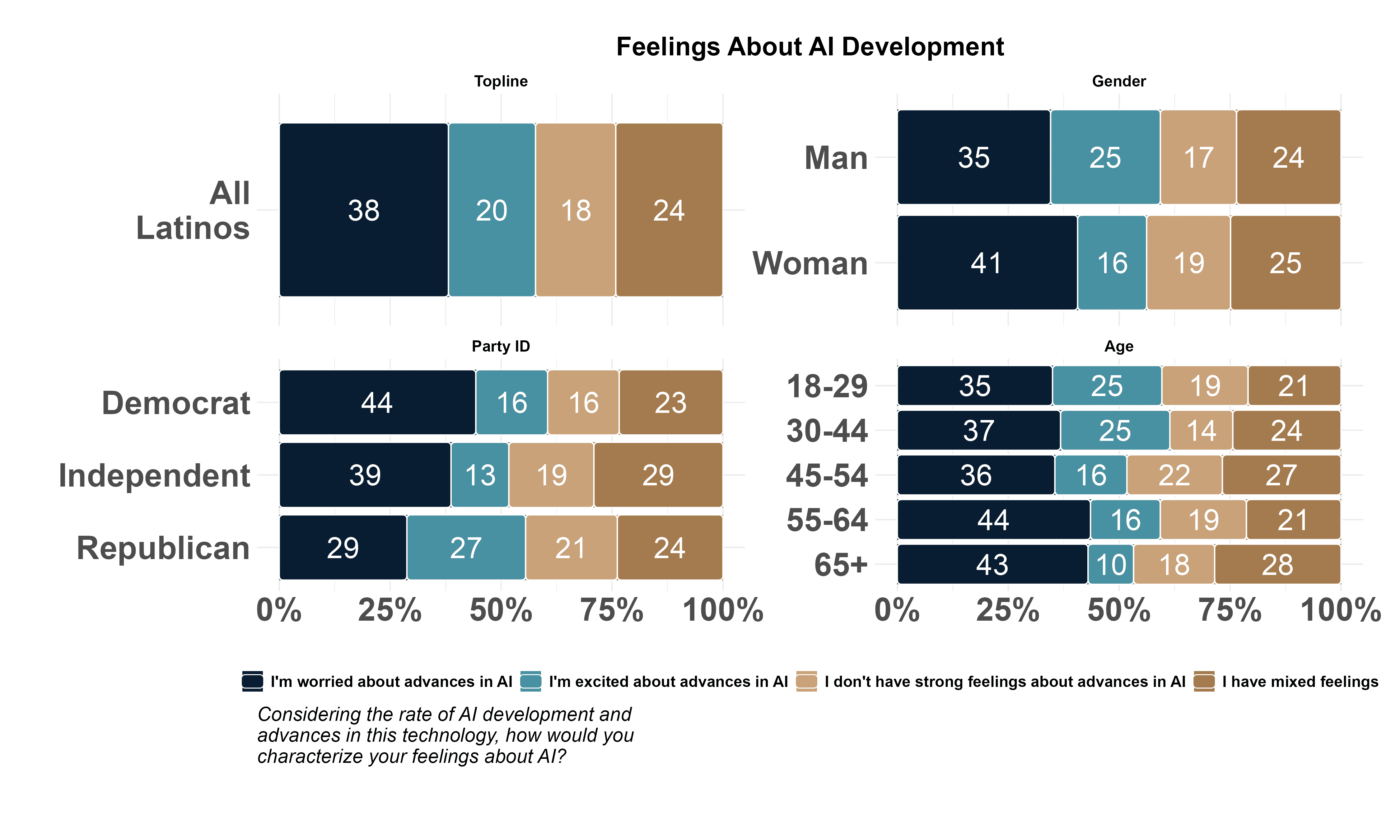
Worry differs by partisanship, gender, and age. For example, a little less than half of Democrats are worried about AI (44 percent), while only about 29 percent of Republicans are.
Latino men are more excited (25 percent) than women (16 percent) are, and older cohorts tend to be more worried about these advances than younger generations are. There is little difference between groups in the share with mixed or no strong feelings.
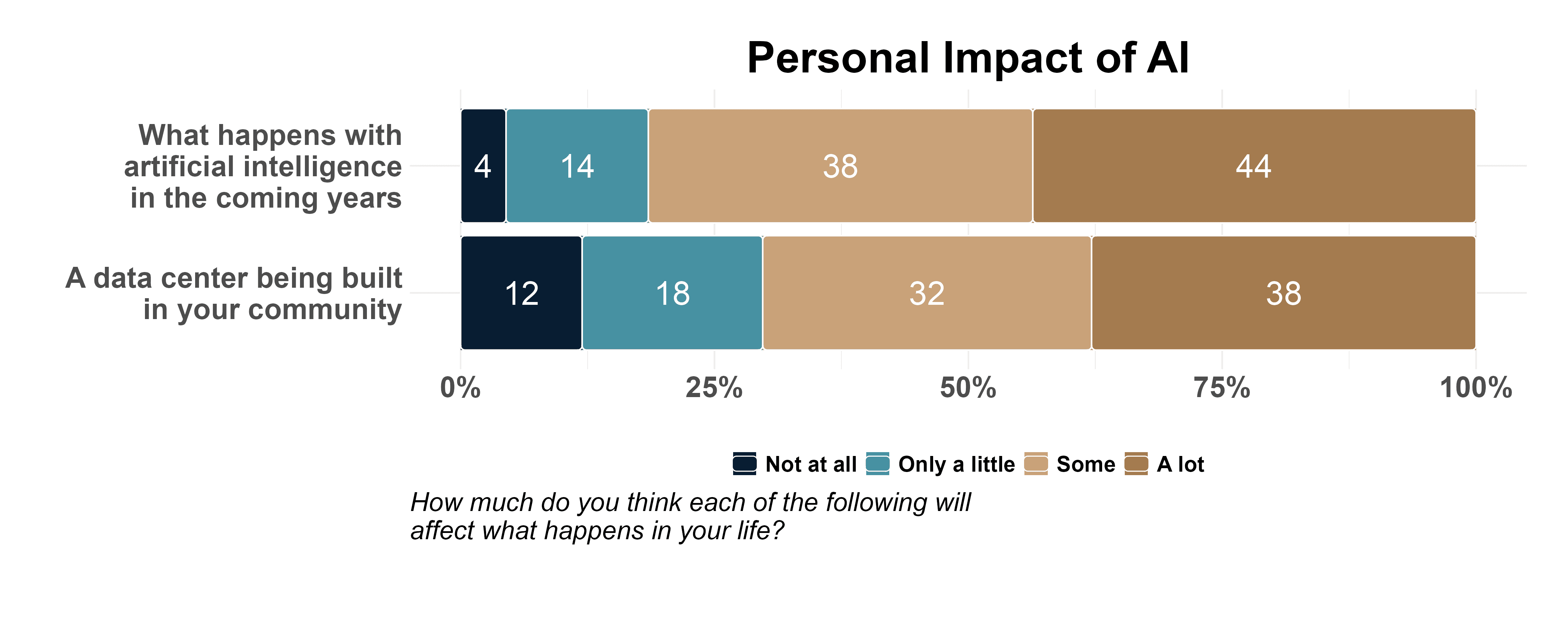
Most Latino voters expect AI to affect their lives.
82 percent of respondents believe that what happens with AI in the coming years will affect what happens in their life. Only about 4 percent of Latino voters say that it will not affect them at all. Men and women, young and old, Democrat and Republican are about equally likely to say AI will affect them. Those who are worried about advances in AI also are more likely to think AI will affect them a lot (55 percent) compared to those who are excited about it (41 percent).
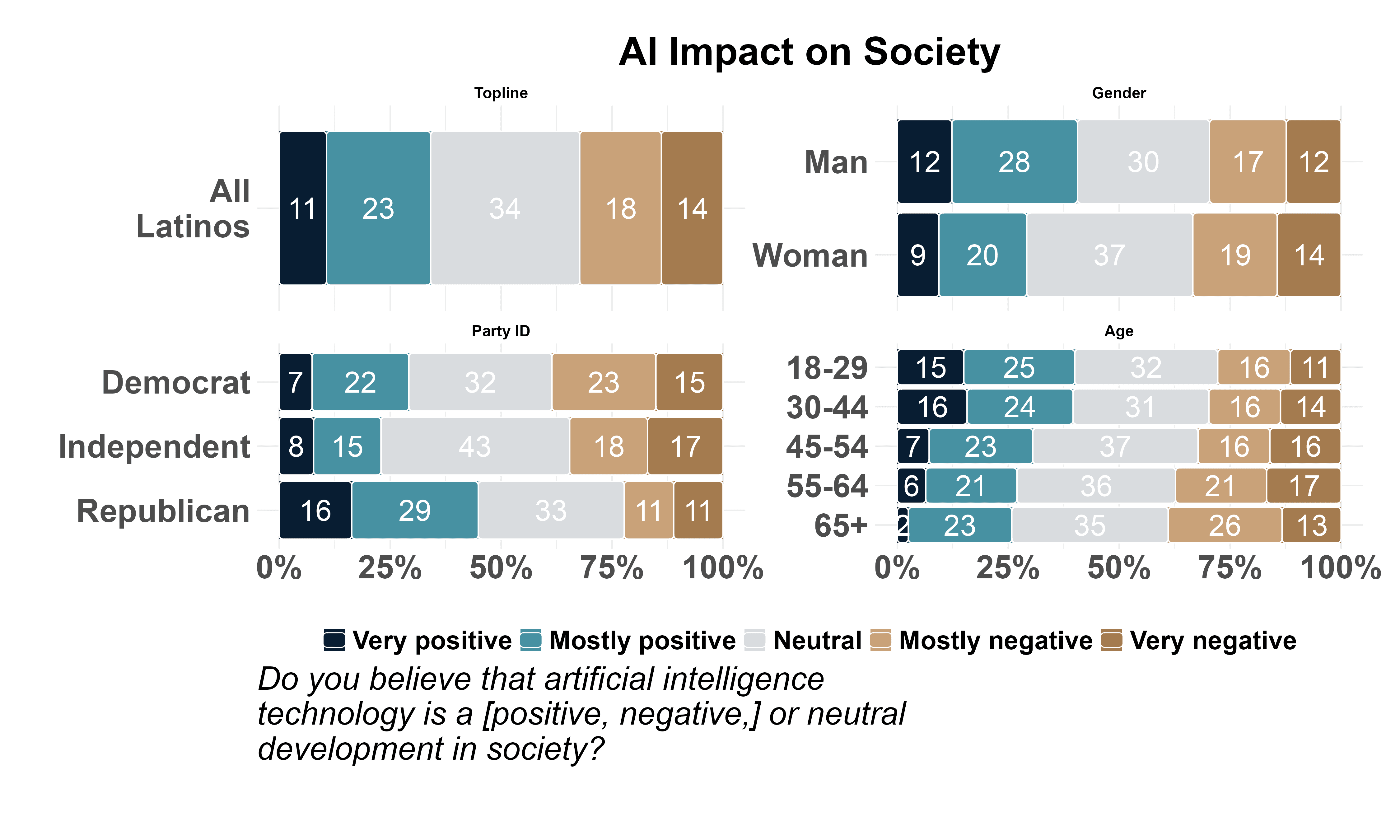
Latinos are, generally speaking, evenly split about whether AI is a good, neutral, or negative development in society.
About a third say that it’s either very or mostly positive, another third that it’s neutral, and another third say it’s negative. However, that even split hides real differences between groups, as some groups are more positive. Among those under 30, 40 percent see AI positively and 27 percent negatively. Men are 40 percent positive while only about 29 percent of women report the same. Republicans are the most positive group, with 45 percent of them saying they see AI positively while Democrats lean negatively (38 percent).
Latino voters’ concerns about AI are mostly connected to perceptions about impacts on everyday life rather than distant, dramatic scenarios.
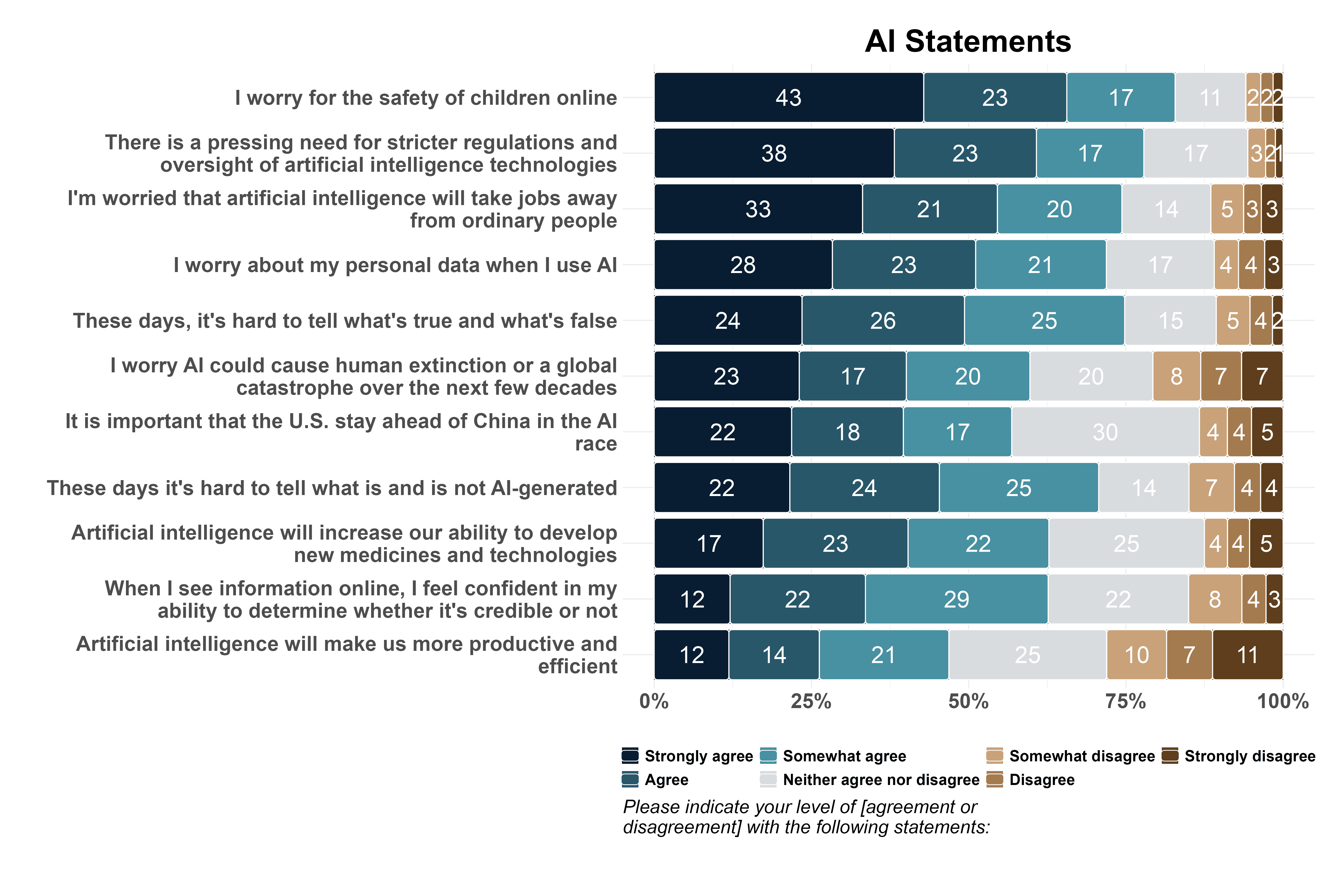
74 percent of respondents worry that AI will take jobs away from ordinary people, 72 percent worry about their personal data when they use AI, and 71 percent say it’s hard to tell what is and isn’t made by AI on the Internet. Fears about AI causing human extinction or a global catastrophe in the next few decades are less common but still shared by 60 percent of people.
These worries sit alongside broader unease about the online world. 83 percent of Latino respondents worry about the safety of children online, and 75 percent say it’s hard to tell what’s true and what’s false on social media these days, though 63 percent still feel confident in their own ability to judge whether information is trustworthy.
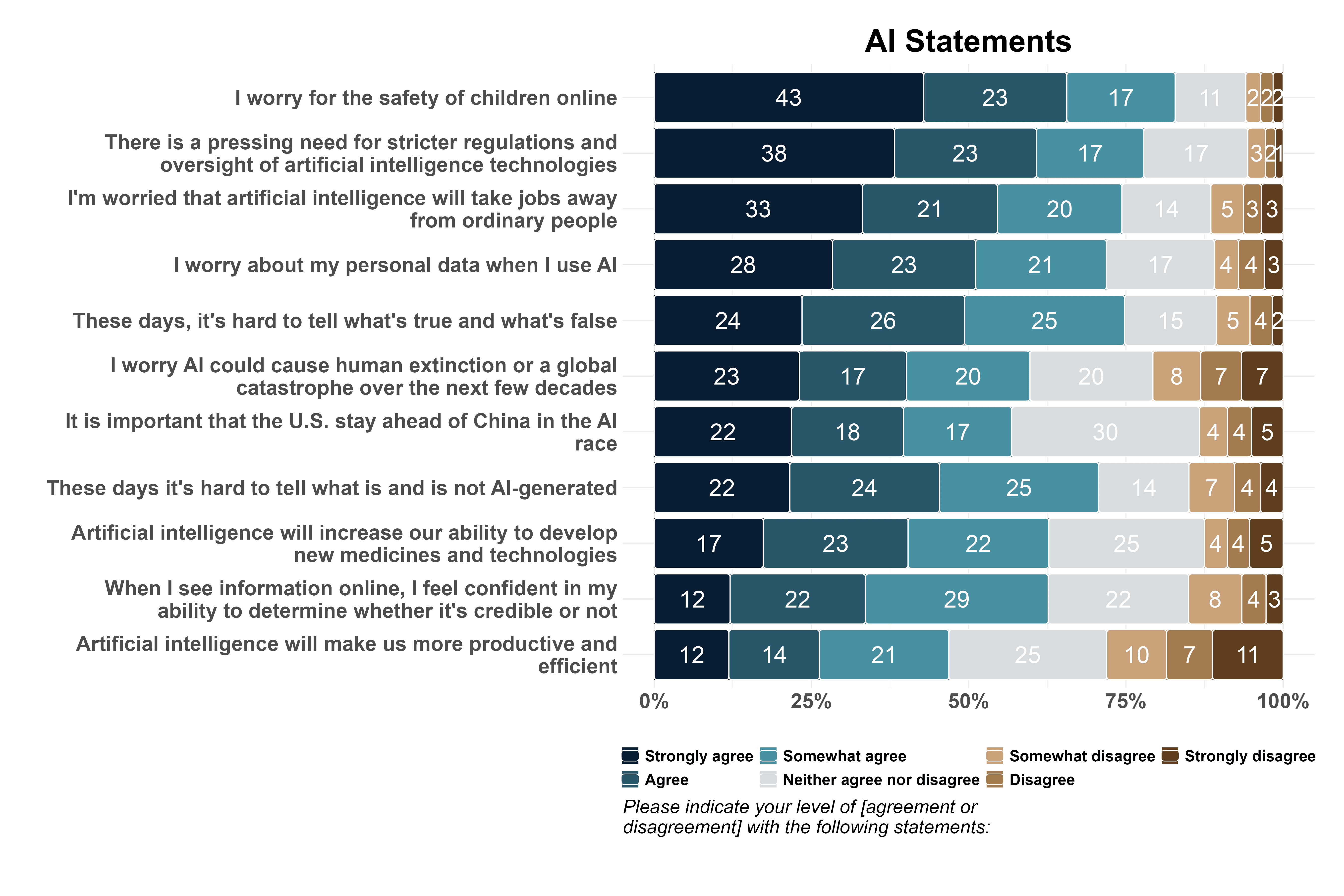
Concerns about AI’s impacts are broadly shared across groups, but a few grow noticeably with age. Worry about children’s safety online, for example, rises from 77 percent among Latino voters under 30 to 91 percent among those 65 and over. The share of those who say it’s hard to tell what is AI-generated rises from 64 percent to 82 percent across the same age groups.
Older Latino voters are also less confident in their ability to judge the credibility of information online: while 71 percent of those under 30 feel confident, about 55 percent of those 65 and older do so. At the same time, worry about AI taking jobs is about the same across age groups and gender, but it is higher among Democrats (80 percent) than Republicans (69 percent).
Other views, including about the opportunities associated with the growth of AI, are more mixed. Six in ten (62 percent) believe AI will help develop new medicines and technologies, and 57 percent say it’s important for the U.S. to stay ahead of China in AI. Yet fewer than half (47 percent) think AI will make people more productive and efficient.
Men are generally more optimistic about AI’s benefits than women. For example, 71 percent of men believe AI will help develop new medicines and technology and 57 percent of women say the same. Republicans are more positive than Democrats about the importance of staying ahead of China (71 percent vs 49 percent).
Latinos are cautious when it comes to using AI to make decisions about voting.
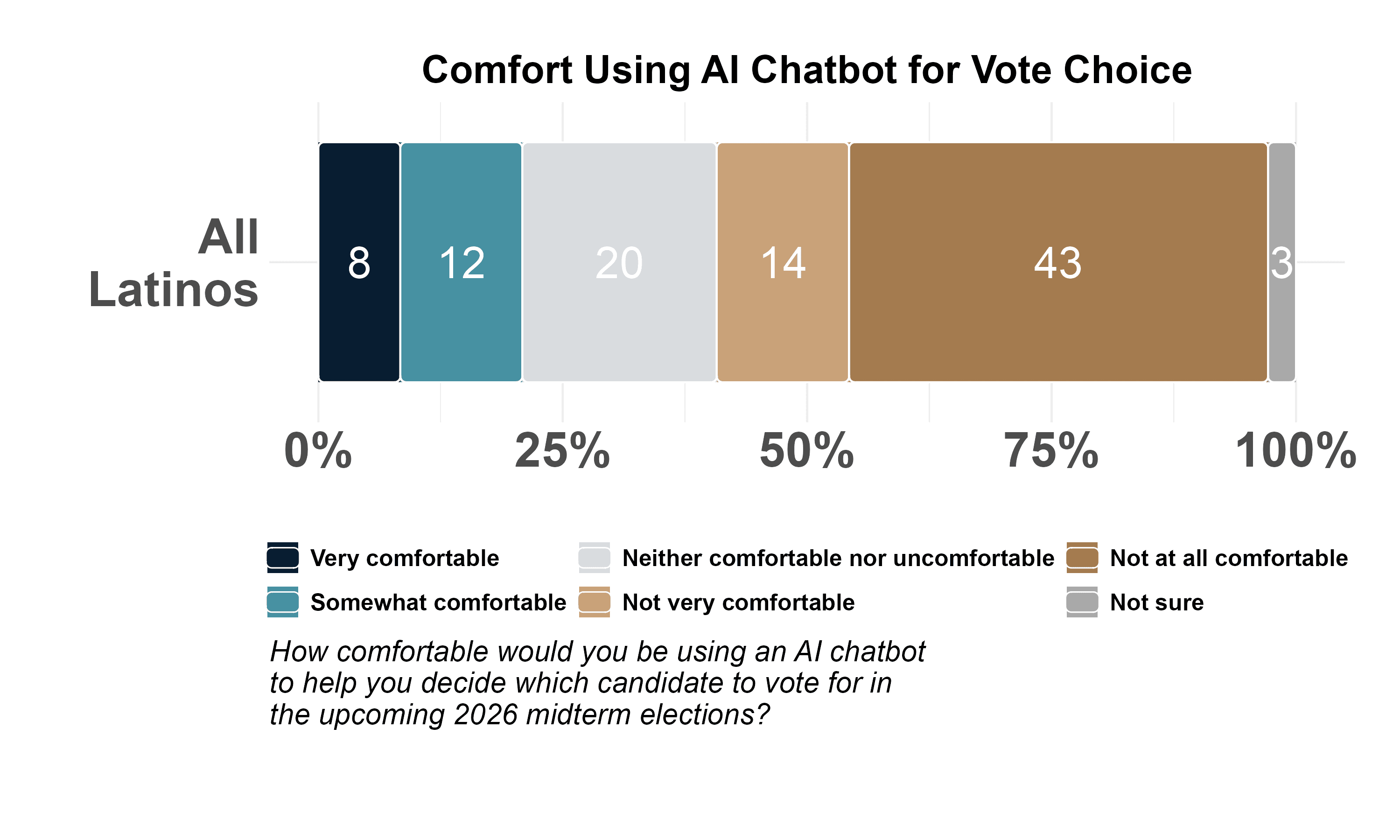
Only 20 percent of Latino voters say they would be comfortable using an AI chatbot to help decide whom to vote for in the 2026 midterms.
57 percent say they would be uncomfortable, including 43 percent who would be not at all comfortable. Even the youngest Latinos are more uncomfortable with this use (41 percent) than comfortable (32 percent).
Latinos’ Perceptions About AI Regulations
Latino voters want firmer rules for AI companies.
There is a clear call for action on regulating AI technologies: 78 percent of Latino voters agree there is a pressing need for stricter rules and oversight of AI. Large majorities in every group agree, including 83 percent of Democrats, 72 percent of Republicans, and 73 percent of Independents. Agreement is highest among Latino voters above the age of 65 (84 percent) and college graduates (82 percent)
When asked about specific proposals, Latino voters clearly favor stronger oversight, particularly around the release of new models.
When asked about various policies proposed, two in three (67 percent) affirmed they support requiring AI companies to submit risk assessments before releasing new models, while a similar figure supports requiring AI systems to be reviewed and approved by an independent body before release. And 61 percent support pausing development of advanced AI until safety standards are in place.
Support for these oversight proposals crosses party lines, with majorities of respondents across parties supporting each. For example, 73 percent of Democrats and 62 percent of Republicans support requiring risk assessments to the US Department of Commerce before new models are released.
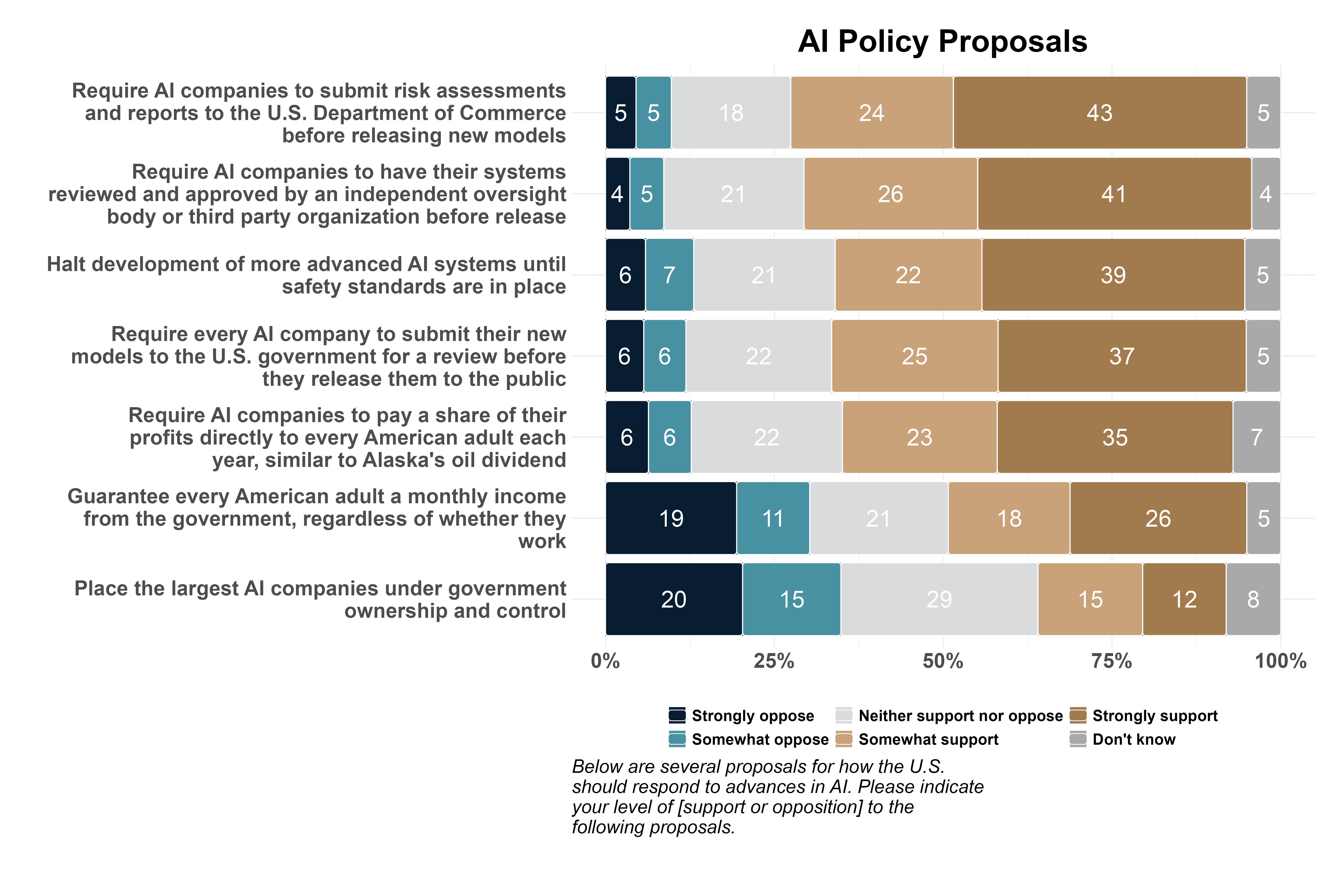
Ideas that go beyond regulating AI companies get a more mixed response.
Many are open to sharing AI’s profits more widely. About three in five (58 percent) support requiring AI companies to share a portion of their profits with every American each year, and 44 percent support a guaranteed monthly income from the government. Not surprisingly, a policy suggesting putting the largest AI companies under government ownership and control is unpopular: while 27 percent support it, 35 percent oppose it, and 37 percent are undecided. Younger voters are more open to this idea; about a third of respondents under 30 support government ownership, compared to just about one in six over 65 years old.
Trust in Stakeholders to Handle AI
Trust is scarce and scientists are the only trusted voice on AI.
Topline: While Latino voters want AI companies held accountable before new products reach the public, they do not really trust the companies, tech leaders or most politicians to do it. Scientists are the one group with broad positive trust on this issue, but they are not the ones currently writing the rules.
Asked who they trust to keep them safe as AI develops, Latino voters express more distrust than trust toward almost everyone listed. Scientists are the one clear exception: 50 percent trust them, and only 21 percent do not. Trust in scientists is highest among Democrats (62 percent) and lower among Republicans (38 percent).
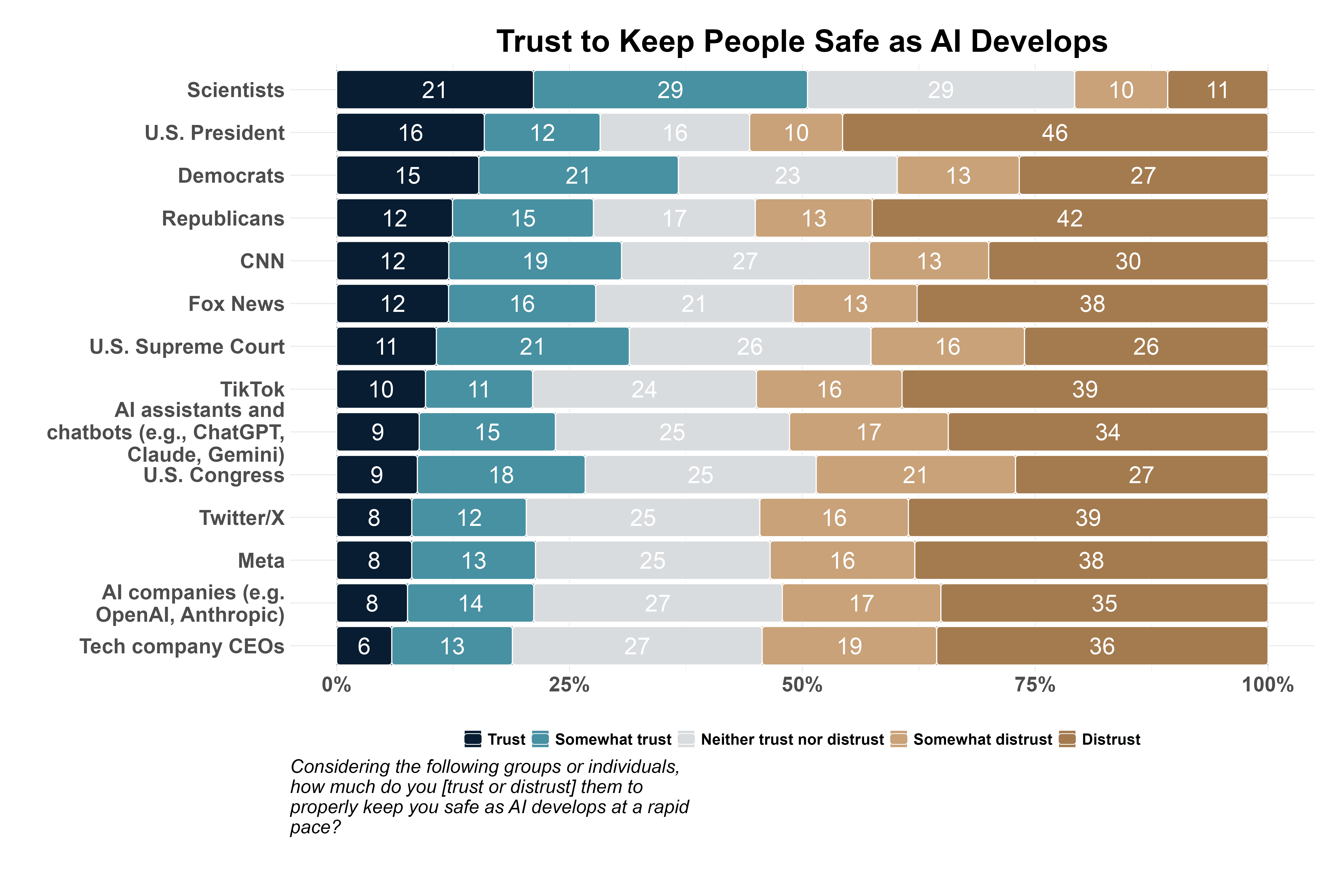
Every other group asked about in this poll is distrusted by more people than trust it:
The AI industry is among the least trusted. Tech company CEOs (19 percent trust, 55 percent distrust), AI companies such as OpenAI and Anthropic (22 percent trust vs. 52 percent distrust), and AI chatbots themselves (24 percent trust vs. 51 percent distrust) all rank at the bottom. While still skeptical on net, younger voters and Republicans are more trusting of tech companies than older voters and Democrats are.
Social media companies fare no better. Meta (21 percent trust vs. 54 percent distrust), TikTok (21 percent trust vs. 55 percent distrust) and Twitter/X (20 percent trust vs. 55 percent distrust) are widely distrusted.
Political leaders do not fill the gap either. The President (28 percent trust vs. 56 percent distrust), Republicans (27 percent trust vs. 55 percent distrust), Congress (27 percent trust vs. 48 percent distrust) and the Supreme Court (32 percent trust vs. 42 percent distrust) are all distrusted more than trusted. Democrats come closest to even (36 percent trust, 40 percent distrust). Trust in political leaders tends to follow party lines.
Neither party fully owns AI yet
Topline: Latino voters’ views on AI lean toward caution and regulation, positions where Democrats currently have an edge. But with about one in five saying they trust both parties about equally, and about one in eight saying neither party, there is still an opening for either party to own the issue with this community.
Asked which party would better handle a range of issues from healthcare, to the economy, to technological innovation, Latino voters favor Democrats on every issue tested. While Democrats easily lead on issues like healthcare (+25 percentage points), abortion (+23pp), and the economy (+14pp), that lead notably shrinks when it comes to technology.
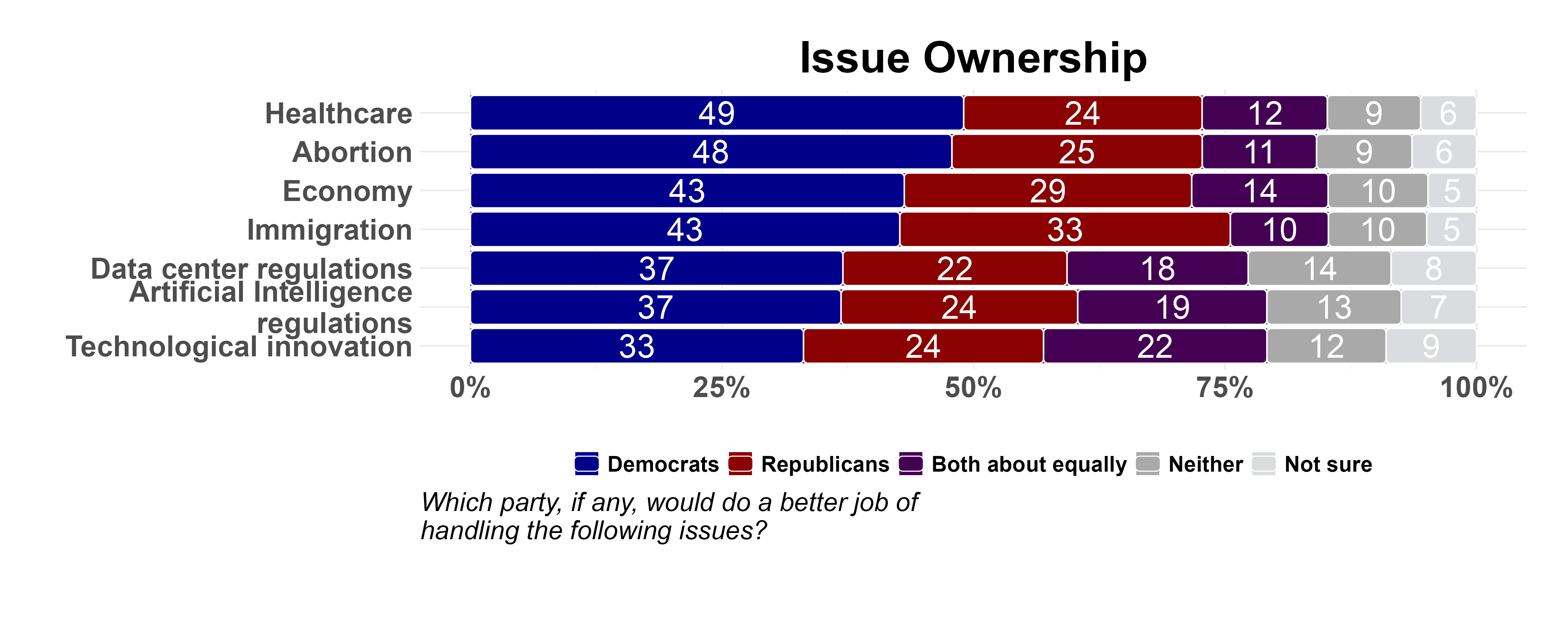
Democrats, on net, still lead on data center regulations (+15pp), AI regulations (+13pp), and innovation (+9pp). However, this share is more similar to the more contentious issue of immigration (+10pp) and economy (+14pp) than to more Democrat-owned issues like healthcare or abortion. However about one in five respondents trust both parties equally on these three (18 percent, 19 percent, and 22 percent, respectively). This is almost double the share of respondents who trust both parties on healthcare, abortion, or immigration.
Specifically, Democrats have an edge around data center regulations among voters under 30 (43 percent vs 18 percent). However, even partisans are less sure of their own party on technology than they are about other issues. For example, while seven in ten Republicans say their party would better handle the economy, only about 57 percent say so about AI regulations and 55 percent on data centers. Among Democrats, the share choosing their own party falls from 73 percent on the economy to about 62 percent on both AI and data center regulation. Most independents either choose neither or say both parties.
Among voters who are worried about AI, Democrats lead Republicans by +28pp on data center regulation, +27pp on AI regulation, and +22pp on technological innovation. Conversely, those who say they are excited about AI say they trust Republicans more across these three items (+7pp, +8pp, and +9pp, respectively). Looking into these technology-related items by demographics also shows some slight differences across gender, but the biggest divide remains worry about AI. For example, 27 percent of men say they trust Republicans more on AI regulation while only 21 percent of women say the same.
Most Latinos do not want to see a data center built in their local area, and many tend to see more drawbacks than benefits to them
Topline: Data centers are a currently low-attention issue among Latino voters with potential to grow. Most Latino voters have not followed the debate closely, yet they already hold firm views about local costs, especially water/electricity bills, and potential regulation. Cost-of-living concerns outweigh the promise of local jobs and investment.
Only about a third of Latino voters are following data centers closely, but most expect to be affected by them.
Data centers are not yet a front-of-mind issue. About one in three Latinos say they have followed this topic a great deal or a lot, with a similar proportion saying they have somewhat followed it, or followed it a little or not at all. Only 13 percent of Latinos said they have not followed this issue at all.
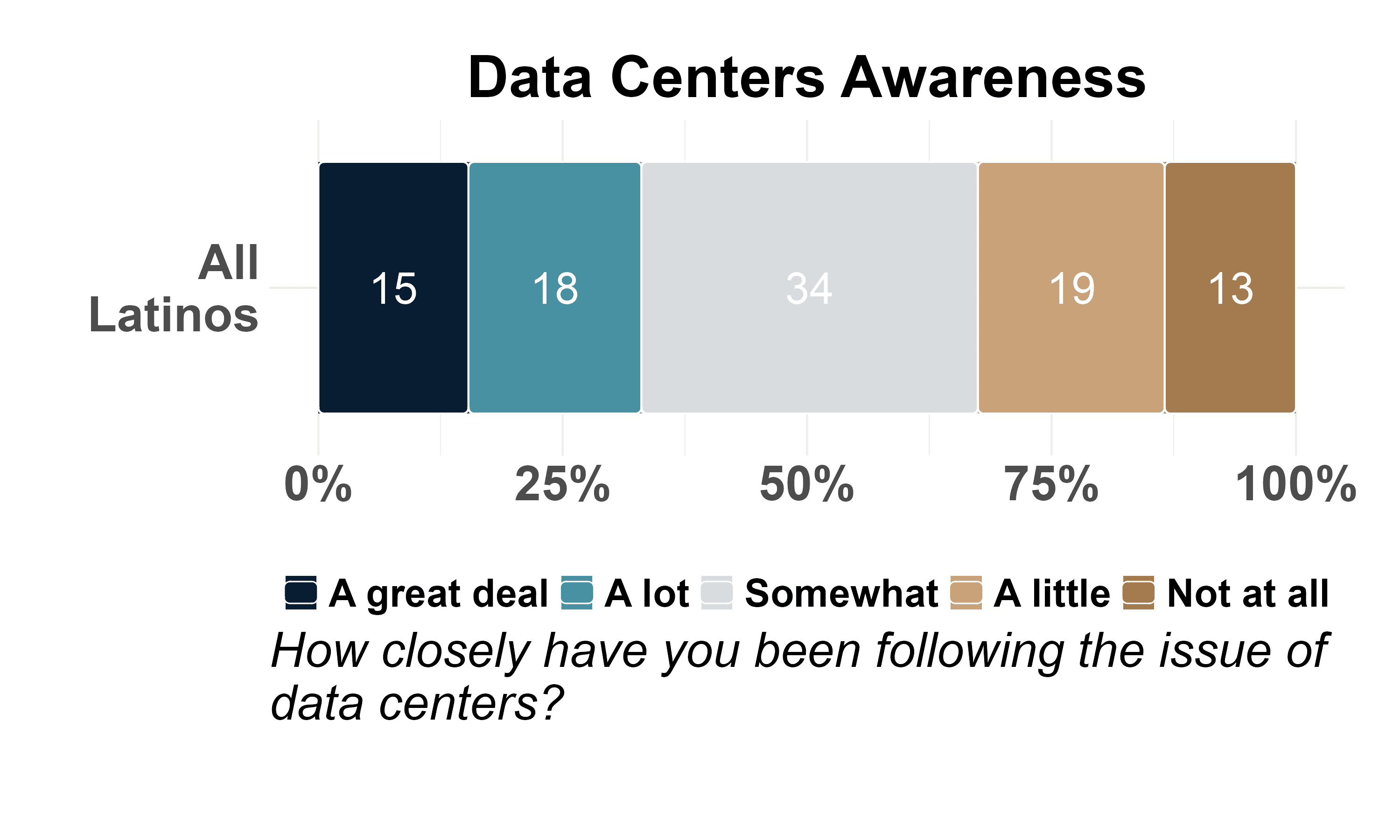
There are some differences across gender and partisanship. For example, men tend to say they have followed the issue more closely than women (39 percent vs. 28 percent), while women are over twice as likely to say they have not followed it at all (19 percent vs. 7 percent of men). Democrats (37 percent) also pay slightly more attention than Republicans (31 percent) or Independents (24 percent). Notably, age is not a clear differentiator in this question; attention is substantively about the same among those under 30 (38 percent) and those 65 and older (30 percent).
Even so, most Latino voters expect data centers to affect them. Seven in ten (70 percent) say a data center built in their community would affect their life at least somewhat, and 38 percent say it would affect them a lot.
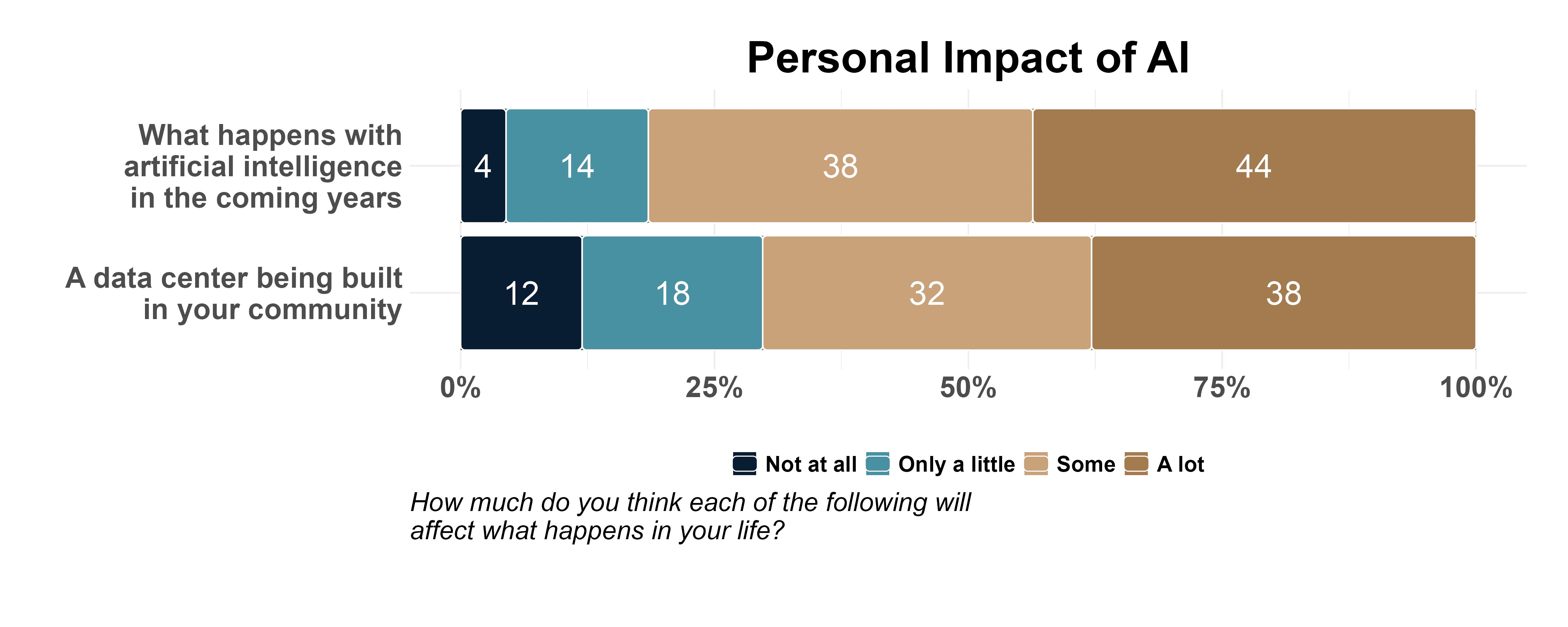
At the same time, opposition to data centers is strongest closer to home.
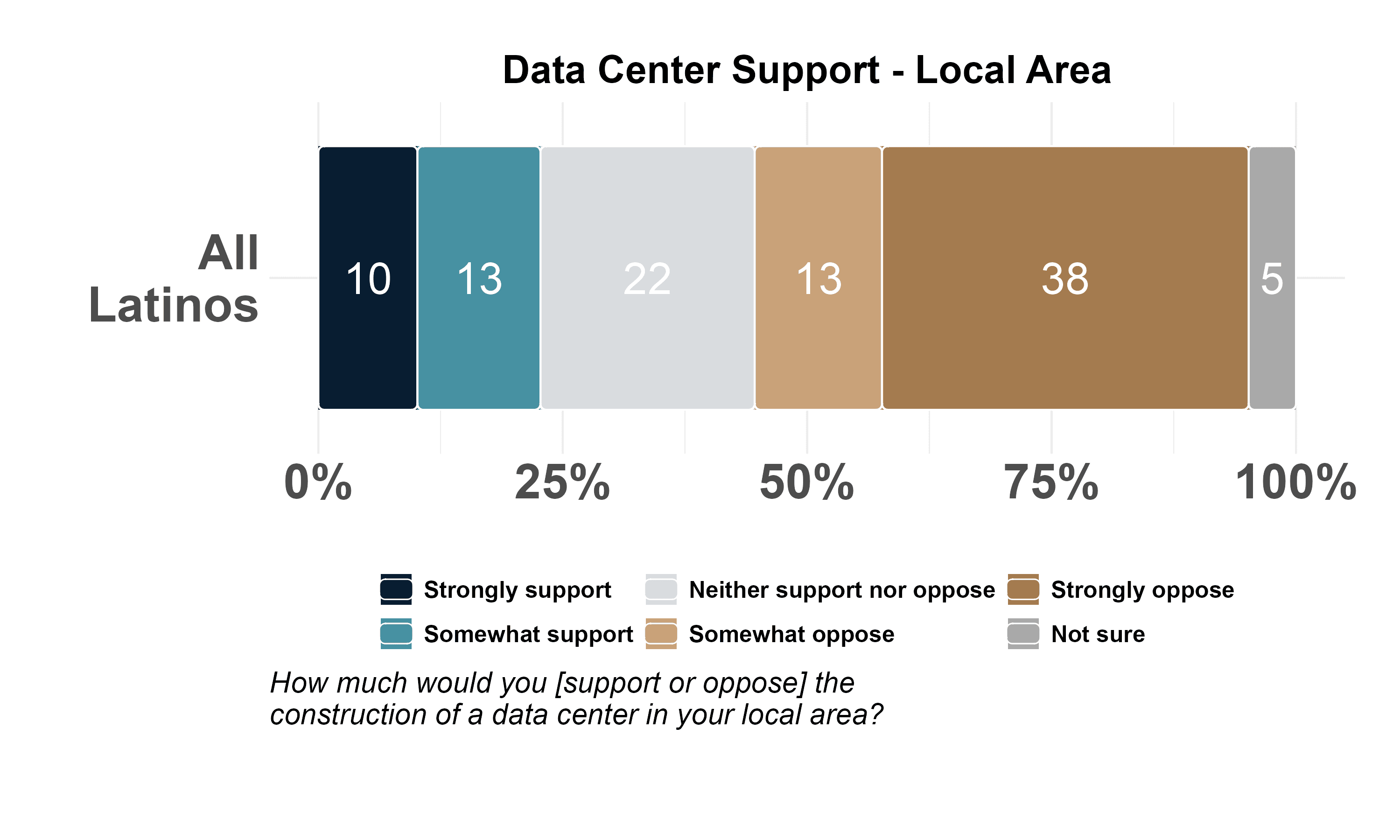
About half of Latino voters (51 percent) oppose building a data center in their local area, with 38 percent strongly opposing it. Fewer than one in four (23 percent) support these data centers in their local community, with only one in ten strongly doing so. Strong opposition is higher among women (41 percent strongly oppose, while only about 32 percent of men do so), Democrats (48 percent strongly oppose), and Independents (45 percent).
Conversely, support is highest among voters under 30 (27 percent strongly or somewhat support data centers in their communities) and Republicans (37 percent support it overall). There is also a sizable share of respondents who either neither support nor oppose data centers (22 percent overall) or are unsure (5 percent), leaving about a quarter of the Latino electorate open to persuasion.
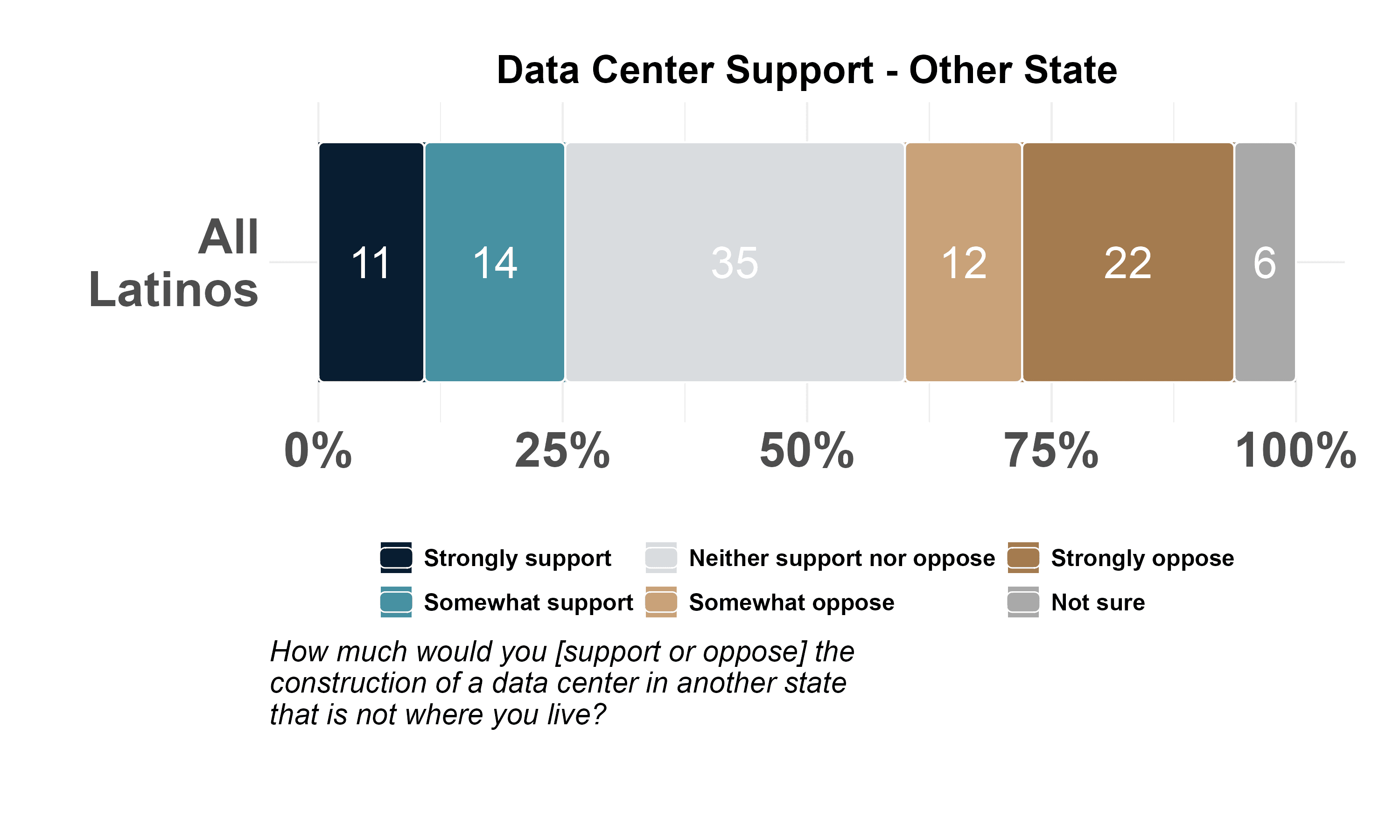
When the data center would be in another state, opposition falls to about a third (34 percent), and strong opposition drops from 38 percent to 22 percent. Support barely moves, rising to about one-in-four. Most of the change goes to the middle: 35 percent neither support nor oppose a data center being built somewhere else. Partisans are split here as well: Democrats oppose a data center in another state by 44 percent to 20 percent, while Republicans support one by 36 percent to 19 percent. However, Latino voters are not so much against data centers in general as against having one nearby them.
Latino voters are pro-regulation of data centers, and tend to worry about costs more than believe in the benefits of these centers.
Specifically, about three quarters of Latino voters agree that there is a pressing need for stricter rules about where data centers can be built (78 percent), worry that data centers drive up bills (74 percent), and about two thirds believe these centers put strain on water resources (68 percent). Fully 72 percent also agree that they are concerned about the broader impact of AI and large technology companies on jobs and society.
The views about costs generally cross party lines.
Most Republican Latino voters agree there is a pressing need for stricter rules about where data centers can be built (72 percent), worry about higher electricity bills (64 percent), and say data centers strain local water supplies (55 percent). And Democrats are even more concerned: 83 percent want stricter rules, 81 percent worry about bills and 77 percent are concerned about water.
When it comes to benefits, Latino voters are more lukewarm.
Only about half (49 percent) agree that data centers are essential for everyday websites, apps, and AI tools. About two in five (42 percent) of Latino voters agree that data centers are necessary for the US to stay ahead of other countries in AI matters, while about a third (29 percent) disagree with this statement. Finally, 40 percent of Latino voters agree data centers bring good jobs and investment to the communities where they’re built, and 32 percent disagree with that statement.
Yet, the benefits of data centers is where the parties split most clearly. Republicans are much more likely than Democrats to agree that data centers bring good jobs and investment (55 percent vs. 32 percent), are essential for everyday technology (61 percent vs. 46 percent), and are needed to stay ahead of China (58 percent vs. 32 percent). Among Democrats, more disagree than agree that data centers bring good jobs (41 percent vs. 32 percent). Men are also more convinced of the benefits than women, for example on whether data centers are essential (60 percent vs. 42 percent). In short, Republicans see both the costs and the benefits of data centers, while Democrats mostly see the costs.
The issue of data centers’ benefits and drawbacks is far from settled.
About three in ten Latino voters do not have an opinion on the claimed benefits of data centers, suggesting that they might be open to messaging about them. Conversely, only about one in ten disagree with any of the drawbacks outlined in the survey, and concern is mostly higher among those who have followed the issue closely than among those who have not.
Conclusion
Latino voters are living with AI before they have become comfortable with its larger social or economic implications. Many already use AI tools, especially younger voters and men, and some are starting to rely on AI for information. However, a large share of Latino voters are worried about AI rather than excited about it, and a strong majority expects AI to shape their lives in the coming years.
Latino voters’ concerns are practical: they worry about jobs, personal data, children's online safety, and the impacts of data centers. These concerns are generally translating into support for clear rules around AI, especially when it comes to safety checks before AI is deployed, but not into support for a government takeover of the industry.
The issue of who the public trusts about AI is still an open question. In the fall of 2026, the Latino electorate’s trust in the people and companies currently shaping AI and its policy is remarkably low. Scientists are the only group that more Latino voters trust than distrust. Additionally, while Democrats currently have an edge over Republicans on which party would do a better job of handling AI regulations, data center regulations, and technological innovation, almost 40 percent of Latinos say both parties would do equally well, neither would, or are not sure.
Finally, perceptions of data centers specifically show how the AI debate can become personal. While most Latino voters have not followed the issue closely, many oppose a data center being built in their community and fewer oppose one in another state. At the same time, Latino voters are already holding firm views about the need for data center regulation and the impact of these centers on cost-of-living matters, while the promise of local jobs and investment is not yet landing as clearly among them.
All in all, Latino voters are open to AI and are using it, but want clear protections in place as AI and data centers grow in their communities and beyond. Trust is low across most of the people and institutions shaping AI, presenting a potential opportunity for whoever earns that trust.
Methodology
This survey is based on 1,500 interviews conducted by YouGov on the internet of Latino registered voters. The sample was weighted according to gender, age, education, and U.S. Census region based on voter registration lists, the U.S. Census American Community Survey, and the U.S. Census Current Population Survey, as well as 2020 Presidential vote and approximate 2024 Presidential vote based on available results, and party identification estimates based on Pew Research Center’s National Public Opinion Reference Survey. Respondents were selected from YouGov to be nationally representative of Latino registered voters. The weights range from 0.2 to 2.69 with a mean of 1 and a standard deviation of 0.46.
The margin of error (a 95% confidence interval) for a sample percentage p based upon the subsetted sample is approximately 2.8%. It is calculated using the formula:

where CV is the coefficient of variation of the sample weights and n is the sample size used to compute the proportion. This is a measure of sampling error (the average of all estimates obtained using the same sample selection and weighting procedures repeatedly). The sample estimate should differ from its expected value by less than margin of error in 95 percent of all samples. It does not reflect non-sampling errors, including potential selection bias in panel participation or in response to a particular survey.
Survey demographic breakdowns
