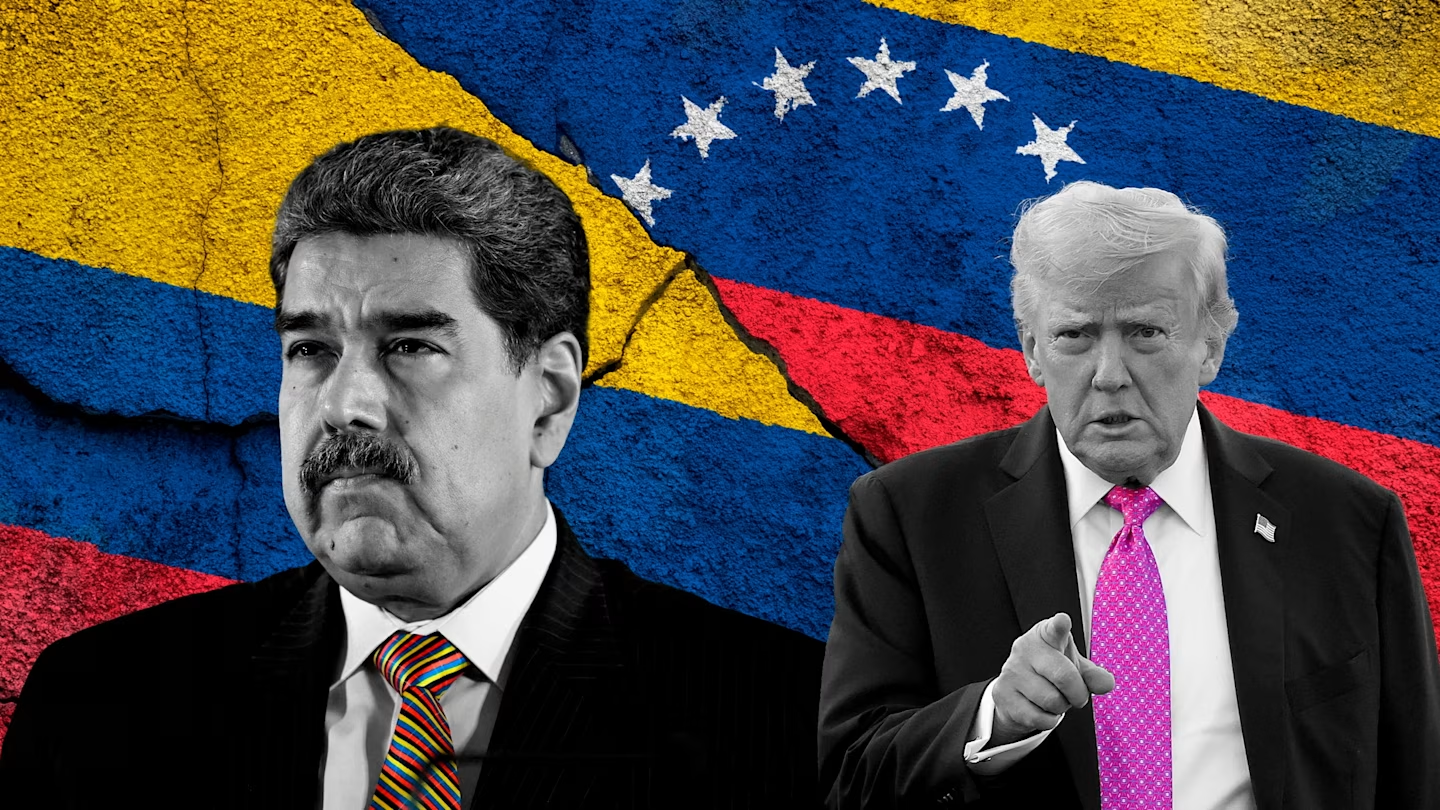
Venezuela: What We Know So Far
As of January 3, 2026 — 4:00 p.m. (ET)
U.S. military operation and capture of Maduro
The United States launched a pre-dawn military strike on Venezuela in the early hours of January 3, 2026.
Airstrikes and attacks targeted key military sites including Fort Tiuna (largest Venezuelan military complex).
U.S. military activity included aircraft and ground forces (e.g., Delta Force reported).
The U.S. Federal Aviation Administration (FAA) temporarily restricted flight operations near Venezuelan airspace and parts of the Caribbean, leading to flight disruptions and cancellations across the region.
Trump framed the explosions and military action as part of a precise, large-scale U.S. strike to capture Maduro, emphasizing operational success and no U.S. casualties while offering no details on targets or civilian impact.
Venezuelan President Nicolás Maduro and his wife, Cilia Flores, were captured and taken out of Venezuela by U.S. forces. They now face criminal charges in the United States:
Federal court in New York charges Maduro with narco-terrorism conspiracy, cocaine-importation conspiracy and weapons charges. Flores, and other senior Venezuelan officials, including Diosdado Cabello, and Maduro's son, are also facing charges.
Attorney General Pam Bondi, in a post on X, wrote that Maduro and his wife "will soon face the full wrath of American justice on American soil in American courts."
Sources:
The Guardian - Venezuela attack: what we know so far as US captures President Maduro
NBC News - Live updates: Trump confirms U.S. strikes on Venezuela, says Maduro was 'captured'
NPR - U.S. hit Venezuela with 'large-scale strike,' captured Nicolás Maduro, Trump says
New York Times - Live Updates: U.S. Captures Venezuelan Leader, Trump Says
CNN - Venezuela President Maduro captured after US strike and will face drugs and weapons charges
NPR - What are the charges against Venezuela's Nicolás Maduro?
Attorney General Pamela Bondi’s X (Former Twitter) account
The White House - President Trump Holds a Press Conference, Jan. 3, 2026
The Wall Street Journal - FAA Temporarily Bans Flying Near Venezuela, Puerto Rico
United States Government Position
U.S. President Donald Trump addressed the situation in a press conference, where he:
Praised the operation’s success, stating it was highly effective and that no U.S. forces were killed.
Said the United States would be “very strongly involved” in Venezuela’s oil industry, with American companies participating in rebuilding and oversight.
Declared that the U.S. would “run the country” temporarily to ensure a stable political transition until a “safe, proper, and judicious” process could take place.
Emphasized that the U.S. is “not afraid of boots on the ground,” noting that troops were already involved at a high level, while suggesting that long-term presence would depend on cooperation.
Said U.S. troops would not remain in Venezuela if Vice President Delcy Rodríguez cooperates with U.S. demands.
Expressed doubt that María Corina Machado could lead Venezuela, stating that she lacks sufficient internal support and legitimacy to govern.
Revealed that a second, larger wave of military action had been prepared but was deemed unnecessary due to the effectiveness of the initial operation.
Sources:
The White House - President Trump Holds a Press Conference, Jan. 3, 2026
Axios - TRUMP: U.S. WILL "RUN" VENEZUELA, NOT AFRAID OF "BOOTS ON THE GROUND"
Venezuelan government response
In a televised address, Venezuelan Vice President Delcy Rodríguez denounced the U.S. operation and Maduro’s capture, saying Venezuela “will never again be a colony of another empire.”
In the early hours of January 3, Defense Minister Vladimir Padrino López released a recorded statement rejecting foreign military involvement and asserting that Venezuela would resist any external troop presence. After that, he hasn’t appeared publicly nor issued additional statements since those initial messages.
Sources:
The New York Times - Venezuela’s Interim Leader Defies Trump and Calls Maduro the ‘Only President’
Axios - Venezuela's VP throws cold water on Trump's solution for running the country
Reuters: Venezuela Defense Minister says will resist presence of foreign troops
Venezuelan opposition response
María Corina Machado publicly celebrated Maduro’s capture, stating that “the hour of freedom has arrived,” in a message published on her official channels (this statement was published before Trump’s Press Conference.)
The statement emphasizes the need to restore democracy and constitutional order.
She calls on Venezuelans and institutions to act with discipline, courage, and responsibility, urging citizens to remain alert and attentive to next steps.
The message provides no operational details, outlining neither a transition mechanism nor her own role.
Source: Machado’s official communication channels
Regional and international reaction
The international response has been mixed. Several governments, including Brazil, and Mexico, condemned the U.S. strikes as violations of international law, national sovereignty, and the UN Charter, while others cautiously welcomed the move as a potential step toward restoring democracy in Venezuela.
The United Nations Secretary-General expressed concern, warning that the operation could set a dangerous precedent. Emergency discussions have been convened within international bodies such as the United Nations and the Organization of American States (OAS).
Sources:
United Nations - US actions in Venezuela ‘constitute a dangerous precedent’: Guterres
Reuters - Brazil says US crossed 'unacceptable line' over military strikes on Venezuela
The Guardian - Venezuela attack: what we know so far as US captures President Maduro
Reuters - World reacts to US strikes on Venezuela
What We Know About the Legal Questions So Far
International law: Experts say Maduro’s capture likely violates the U.N. Charter
Prosecution: U.S. courts are expected to proceed regardless of how Maduro was captured (an unlawful capture would not necessarily stop a U.S. prosecution.)
Running Venezuela: Legal scholars see no lawful basis for the U.S. to govern the country, warning it could amount to an illegal occupation
Sources:
The Guardian - Is there any legal justification for the US attack on Venezuela?
What remains unknown
As of January 3, 2026 — 4:00 p.m. (ET)
Chain of command in Caracas: who currently controls the armed forces and intelligence services, and whether there is a unified military response.
While President Trump has stated that the United States will temporarily oversee Venezuela during a transition, no formal political process has been announced. It remains unclear whether this will involve an interim civilian government, a military council, or a negotiated handoff.
Venezuelan authorities have not announced any formal transfer of power, and Delcy Rodríguez’s current location has not been publicly confirmed.
Reaction from María Corina Machado: It remains unclear how the opposition leader will respond to President Trump’s statements questioning her legitimacy and ruling out her leadership role, and whether she will contest, accept, or remain silent on the U.S.-led transition framework.
Key Chavista figure Jorge Rodríguez have not appeared publicly or issued statements since the events began.
Maduro and Cilia Flores’ exact detention location, jurisdiction, and the immediate legal process remain unconfirmed, despite U.S. statements indicating they will face charges.
Possible further U.S. operations: there is no official confirmation of additional actions targeting other Chavista leaders, including Diosdado Cabello.
Numbers of Venezuelan deaths and injuries have not been independently verified.
Military posture: it is unclear whether the Venezuelan armed forces are divided, neutral, engaged in negotiations, or deliberately avoiding confrontation.