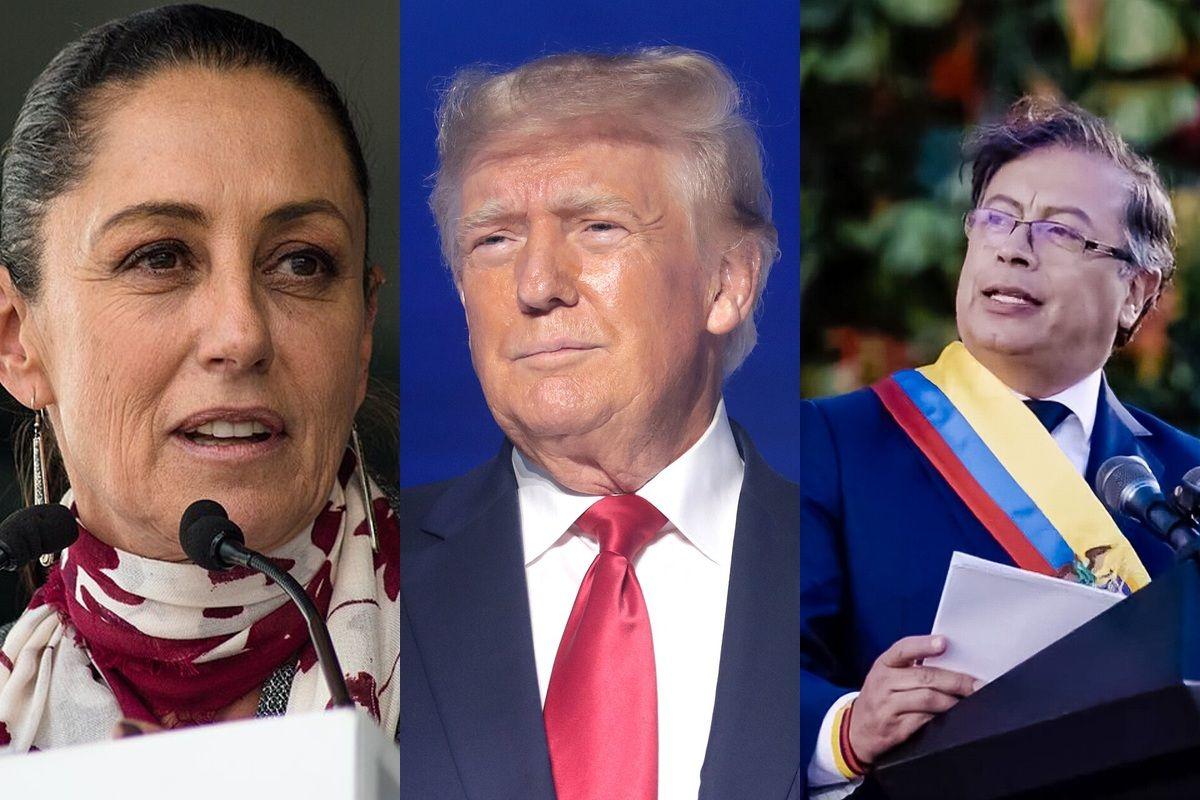
As Trump Suffers Midterm Defeat, His Latin American Allies Remain Quiet
12 Hours After U.S. Midterms, Only Two Latin American Politicians Have Reacted – Both Leftists
As Democrats celebrated their victories in the November 3 U.S. midterm elections, most Latin American presidents remained publicly silent, at least in the social media conversations reviewed by the Digital Democracy Institute of the Americas (DDIA). DDIA found that the conversation about the midterms extended, however, far beyond official congratulations, per an analysis of 446 social media publications — 326 in Spanish and 120 in Portuguese — collected via Sprout Social between midnight and noon on November 4.
By noon Eastern Time on November 4, only Mexico's President Claudia Sheinbaum and Colombia's Former President Gustavo Petro seem to weigh in on the U.S. midterms. Their reactions contrasted with the apparent silence of right-leaning presidents closely associated with Donald Trump, including Argentina's Javier Milei, Colombia's Abelardo de la Espriella, and Ecuador's Daniel Noboa.
Beyond official congratulations, across Latin America, content producers and social media users spent the morning after the midterms debating whether Trump's electoral setback could weaken his regional allies, strengthen progressive movements, and reshape Washington's relationships with Latin American governments.
Detailed breakdowns are below.
Mexico and Colombia: Two left-wing presidents break the silence
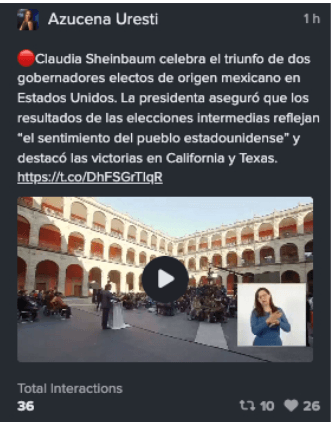
Mexican President Claudia Sheinbaum offered one of the clearest official responses to the U.S. election results. Spanish-language news media outlets repeatedly highlighted her assessment that the Democratic victory reflected the feelings of the American people. She also celebrated the victories of Gina Hinojosa in Texas and Xavier Becerra in California, emphasizing their Mexican roots.
However, Sheinbaum avoided predicting major changes in bilateral relations. She said it was too early to assess the implications for negotiations involving the United States-Mexico-Canada Agreement (USMCA) and stressed that Mexico would continue working with the U.S. government regardless of the electoral outcome. Her response was largely interpreted as diplomatically cautious rather than confrontational.
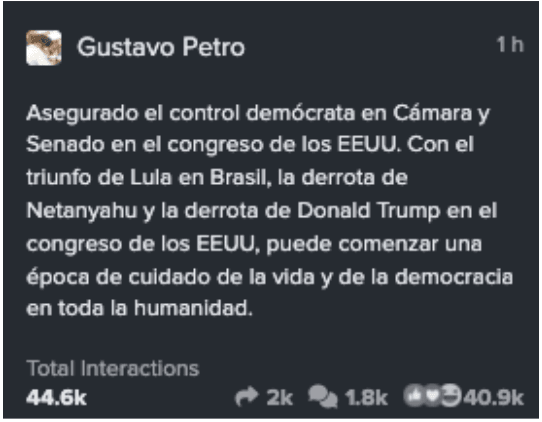
Colombian Former President Gustavo Petro was the other Latin American leader identified as having publicly addressed the election results. He celebrated the victory and tied it to the momentum started a few days ago with Luiz Inácio Lula da Silva in Brazil.
Beyond Petro's response, Colombia's political conversation was particularly ideological. Former presidential candidate Iván Cepeda went to social media to describe the Democratic victories as a defeat for what he called "fascismo trasnacional" ("transnational fascism").
Cepeda also connected the results to Lula's reelection in Brazil and argued that Latino voters had rejected anti-immigrant politics. He also portrayed Trump, U.S. Secretary of State Marco Rubio, and Colombian President Abelardo de la Espriella as politically weakened by the outcome.
Brazil: Progressives celebrate Trump's defeat and question Bolsonaro's future
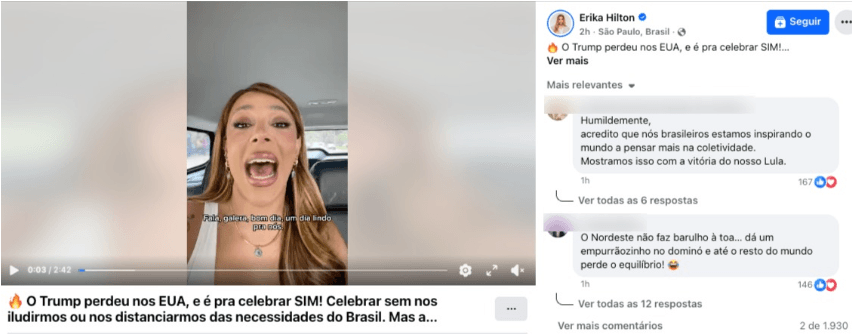
In Brazil, some of the strongest reactions came from progressive politicians and commentators rather than President Luiz Inácio Lula da Silva himself. Congresswoman Erika Hilton wrote on X: "O Trump perdeu nos EUA, e é pra celebrar SIM!" ("Trump lost in the U.S., and YES, we should celebrate!"). She described the results as positive for Brazilians, Americans, and the world, while warning against complacency. Her publication generated 21,799 engagements, making it one of the most engaged-with directly relevant political reactions in DDIA's sample.
Other Lula allies interpreted the Democratic victories as evidence of a broader international political shift. Edinho Silva, president of Partido dos Trabalhadores (Lula's party), quoted by Brasil 247, portrayed Lula as a leading figure in this movement.
Left-leaning content creators also speculated about the consequences for former President Jair Bolsonaro and his family. Renato Rovai, of TV Fórum, suggested that a Democratic-controlled Congress could scrutinize connections between the Bolsonaros and Trump.
Eduardo and Flavio Bolsonaro, currently living in the U.S., were silent on social media on the morning of November 4. Carlos Bolsonaro remained active online but was focused exclusively on Brazil's Congress, without mentioning developments in the United States.
Argentina: Trump loses, but what happens to Milei?
In Argentina, the conversation centered on President Javier Milei's political vulnerability rather than on any direct statement from him. Milei has closely associated his political and economic strategy with the Trump administration, prompting commentators to question whether Democratic control of Congress could complicate Washington's financial support for Argentina.
El Destape radio commentator Ari Lijalad summarized this interpretation in the headline "Perdió Donald Trump, pierde Javier Milei" ("Donald Trump lost, Javier Milei loses"). Radio Con Vos raised a similar question in an editorial titled in caps: "CAE TRUMP ¿TAMBIÉN MILEI?" ("Trump falls. Will Milei fall too?").
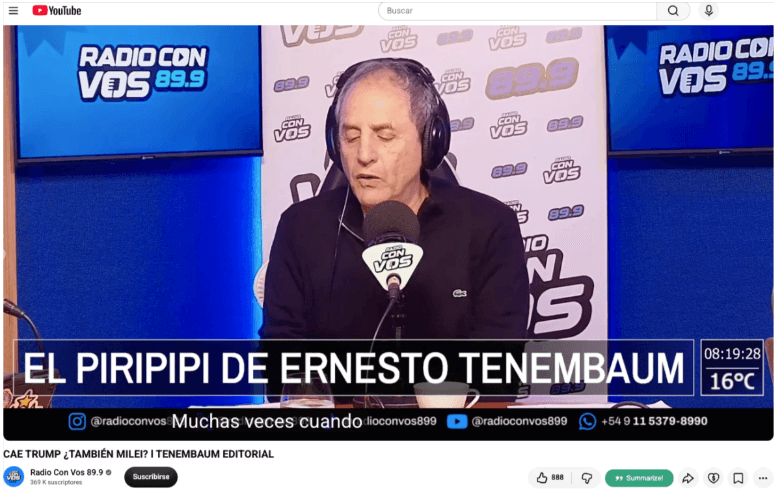
The publications captured by DDIA suggested that some Argentine commentators viewed the U.S. results as a setback for Milei's political strategy. However, they offered no evidence that American financial assistance or bilateral relations had already changed.
As of noon on November 4, DDIA had not identified a direct reaction from Milei.
Venezuela: Less celebration, more uncertainty
In Venezuela, the discussion focused less on Trump's electoral defeat itself and more on whether the results could affect the country's political transition. Opposition figure Henrique Capriles argued that the U.S. election outcome would not change his demand for Delcy Rodríguez and other ruling figures to leave power. He reiterated his call for free presidential elections.
Other social media users debated whether a Democratic Congress could increase oversight of U.S. policy toward Venezuela or complicate the position of the country's current authorities.
Although DDIA's dataset included several publications about Delcy Rodríguez meeting with business leaders, none contained a direct reaction from her to the U.S. election results.
Chile, Ecuador and other Trump allies: Silence becomes part of the conversation
Beyond Argentina, the Democratic victories also generated speculation about the political standing of other right-leaning Latin American leaders. In Chile and Ecuador, social media users portrayed the results as a symbolic setback for politicians associated with Trump, including José Antonio Kast and Daniel Noboa.
One publication grouped Kast, Noboa, Milei, and De la Espriella together as regional figures who could be politically affected by the Democrats' victories.
For more on DDIA's 2026 U.S. midterm monitoring, read:
Methodology
DDIA collected and analyzed raw data from social media and messaging apps using NewsWhip and Sprout Social. Platforms analyzed included Facebook, Instagram, X, YouTube, Bluesky, TikTok and WhatsApp. The data underpinning this analysis was collected between 00:00 a.m. ET and 12:00 p.m. ET on Wednesday, November 4, 2026. All searches were conducted in Spanish and English.