This article was also published in REDESCover, DDIA’s weekly newsletter. Click here to subscribe and get the next edition delivered straight to your inbox.
Brazil heads into Sunday’s (October 4) presidential election deeply polarized, with high rejection rates for both leading candidates: President Luiz Inácio Lula da Silva, of the left-wing Workers’ Party (PT), and Senator Flávio Bolsonaro, of the right-wing Liberal Party (PL) and son of former President Jair Bolsonaro.
Lula, 80, founded the PT and is seeking reelection. A former metalworker and union leader, he governed Brazil from 2003 to 2010 and returned to the presidency in 2023 after defeating Jair Bolsonaro.
Flávio, 45, is a senator from Rio de Janeiro, lawyer and businessman who previously spent 16 years in the state legislature. He is running for president for the first time, carrying the Bolsonaro family’s conservative political project into another national election.
But Brazil’s final campaign days have been shaped by far more than traditional debates over the economy, public security or social policy. Voters are navigating a major corruption scandal potentially involving a banker and prominent Supreme Court justices, religious disinformation, distorted statements about women and children, allegations involving sex workers and expensive gifts, and a sudden government crackdown on online gambling.
In this second article of a three-part series, our researchers examine the latest disinformation impacting the campaigns.
Read part two below and parts one and three for a closer look at the other controversies defining the final days of the campaign in Brazil.
Religion, viral distortions and scandals shake Brazil’s final campaign days
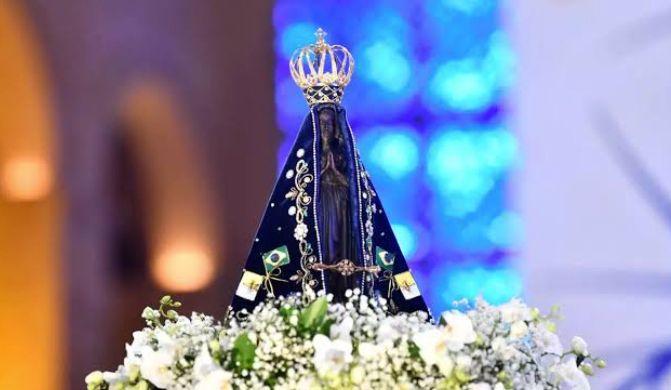
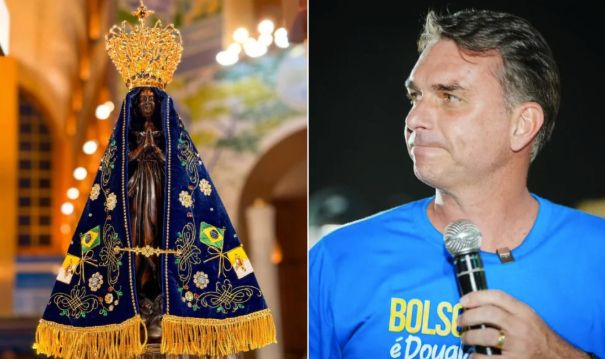
Brazil’s equivalent of an “October surprise” arrived through an unlikely combination of religion, social media and the country’s patron saint. Our Lady of Aparecida (a Black representation of the Virgin Mary and one of the most important religious symbols for Brazilian Catholics) became the center of a last-minute political battle after Flávio Bolsonaro said that, if elected, he would declare that “Brazil belonged to Jesus Christ.”
Social-media posts quickly transformed that statement into something Bolsonaro had not proposed: a plan to strip Our Lady of Aparecida of her official status as Brazil’s patron saint.
The claim was false. Posts used a bill introduced by another politician nearly two decades ago (and shelved in 2008) to portray Bolsonaro as hostile to one of Brazil’s most important Catholic symbols.
The episode illustrates how religion, already a powerful political force across Latin America, can become particularly potent when combined with electoral disinformation. It also did not remain confined to social media: Lula amplified the controversy against his opponent even though the underlying claim was false. The Virgin became a powerful weapon in the last day of the campaign before the first round.
Lula’s words become ammunition for his opponents
But Lula also faced his own viral controversy, showing how quickly an awkward statement can be stripped of context and transformed into a much more inflammatory political message.
At a campaign event, the president criticized men for avoiding prostate examinations and compared their reluctance with women’s experiences undergoing medical exams. He said women learn from an early age to receive toque, a Portuguese word that can mean physical “touch,” but can also refer to a medical examination.
Opposition politicians, led by far-right congressman Nikolas Ferreira, recast the remark as evidence that Lula was normalizing the sexual abuse of women or children.
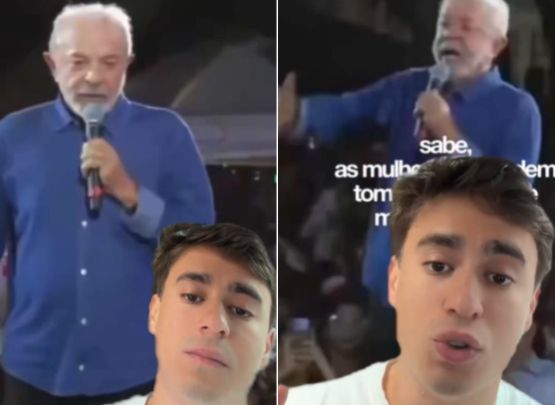
That was not what Lula had said. But the accusation spread widely enough that his campaign turned to the courts, requesting the removal of posts that gave his remarks a sexual meaning.
Taken together, the two episodes reveal a similar campaign tactic operating in opposite directions: take a statement or historical reference, remove crucial context, attach an emotionally powerful interpretation and push it through social media during the final days before voting.
Flávio faces allegations involving sex workers, gifts - and political access
Not all of the controversies shaking the campaign, however, originated online. On September 29, Brazilian news outlet PlatôBR reported on messages, photographs and documents held by Alexandre Santini, a former business partner of Flávio Bolsonaro, alleging the candidate participated in private parties involving sex workers.
The reporting also described a white-gold Rolex valued at R$305,000 allegedly purchased for Bolsonaro by lawyer Alan Belaciano, as well as more than R$90,000 in gym equipment. UOL news portal reported that Bolsonaro had previously characterized the equipment purchase as a personal loan that he was repaying.
But the more consequential issue may not be Bolsonaro’s private life. It is access.
The material suggests Bolsonaro approached Supreme Court Justice Kassio Nunes Marques regarding a client’s interests, raising questions about the intersection of gifts, political relationships, and access to powerful officials.
The available material does not establish a corrupt exchange. Nunes Marques’s office said the justice meets lawmakers from across the political spectrum without compromising his impartiality. The allegations remain media reports, not judicial findings.
That distinction is important in a campaign increasingly saturated with claims whose evidentiary strength varies considerably.
Lula’s betting crackdown opens another political front
Lula, meanwhile, created an offline controversy of his own by targeting an industry that has become deeply intertwined with Brazil’s national obsession: soccer.
On September 25, the president issued a provisional measure prohibiting online betting, reversing the regulated market developed during his own administration. The measure still requires congressional approval to become permanent.
Lula has framed the crackdown around gambling addiction and the impact of betting on household finances. The policy has attracted substantial public support, particularly among women voters. But it also threatens a business model that Brazilian soccer has come to depend on.
Betting companies have become major sponsors of Brazilian clubs, generating roughly R$1 billion in advertising revenue in 2025, according to Reuters. That means restricting online betting is no longer simply a public-health or consumer-protection debate. It directly challenges a major source of revenue for Brazil’s most popular sport.
The result is another political tradeoff just days before the election: Lula can point to public support for confronting gambling-related harm, while soccer fans and clubs worry about the financial consequences.
Together, these controversies capture the intensity of Brazil’s final campaign days. Religion, manipulated context, personal allegations, questions about access to power and the economics of soccer are now competing with traditional policy debates for voters’ attention.
And with voting only days away, the distinction between what is documented, what is alleged, and what is demonstrably false has become increasingly important.