This article was also published in REDESCover, DDIA’s weekly newsletter. Click here to subscribe and get the next edition delivered straight to your inbox.
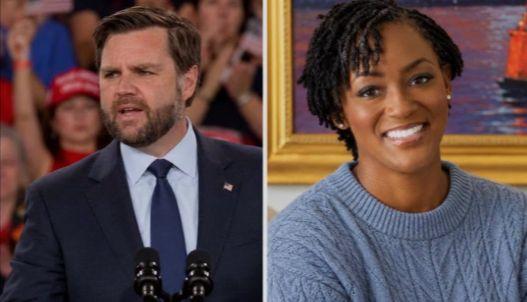
Vice President J.D. Vance went to Florida last week with a blunt message about Angie Nixon, the Democratic nominee for U.S. Senate. He did not simply argue that her politics were too far left. He suggested that her political views meant she did not belong in the United States.
“When Angie Nixon calls herself a socialist,” Vance told a crowd in Lakeland on Oct. 1, “I think the right response is to say, ‘Then get the hell out of here. You don’t belong in America if those are your views.’”
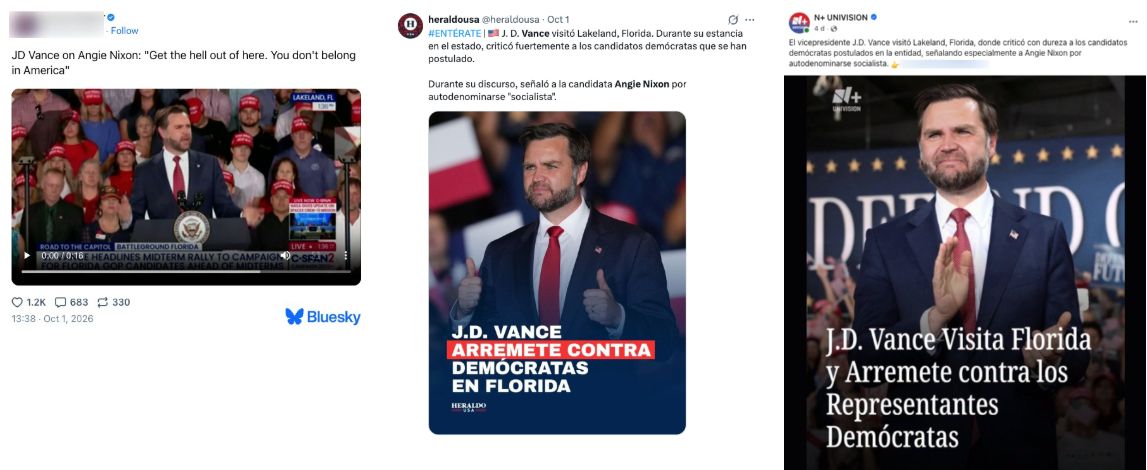
The line drew applause and quickly spread online. It also crystallized a central Republican strategy against Nixon, a Black state representative who pulled off one of this year’s biggest Democratic primary upsets and is now challenging Republican Sen. Ashley Moody in Palm Beach (President Trump's home county).
For the state’s Latino electorate, that strategy revolves around one of the most politically charged words in American politics - socialist.
More than one hundred Spanish-language Facebook, Instagram, X, YouTube and BlueSky posts reviewed by DDIA this week explicitly focused on Vance’s attack, generating at least 327 interactions and 260 comments. These numbers show (once again) how quickly a message delivered at an English-language Republican rally crossed into Spanish-language political conversations.
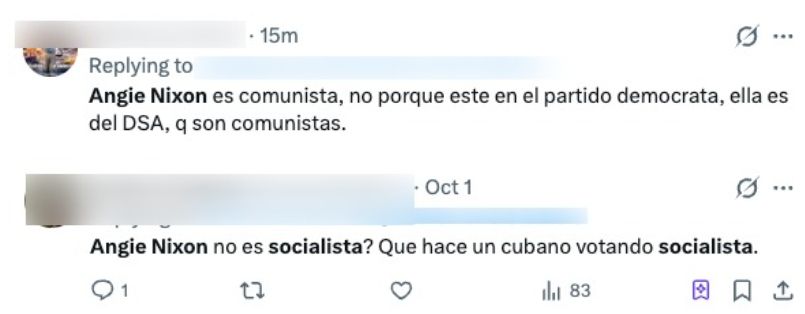
A sentiment analysis of those comments indicate that, while the vast majority of Spanish-speakers mocked Vance as scared or politically desperate and accused Republicans of hypocrisy, pointing to the Trump administration’s relationship with China, some vocal conservative groups aligned with the vice president. In this universe, Spanish-speaking Latinos commenting on social media explicitly equated Democrats with socialism and communism and praised Vance, Trump and the Republican Party, proving that “socialism” remains a powerful political weapon.
From DSA member to “socialist”
\The Nixon case also illustrates how political information can be manipulated without fabricating a story from scratch. Nixon did join the Democratic Socialists of America (DSA) in June. But the organization does not appear to have endorsed her Senate campaign, and Nixon has repeatedly said that membership does not mean she embraces its entire platform. She has rejected, for example, the organization’s call to abolish prisons.
The distortion, one of the 5 Ds of disinformation, works by erasing those distinctions. For misinformers online, Nixon’s DSA membership is itself used as evidence that she holds positions she says she does not. Her broader political agenda (including health care, childcare, housing and public education) disappears. These actors are using “socialist” as shorthand for something broader and more threatening related to Latino's past in other nations. Vance carried that logic one step further. He connected socialism to being un-American. From there, he took being un-American to meaning “you don’t belong here.”
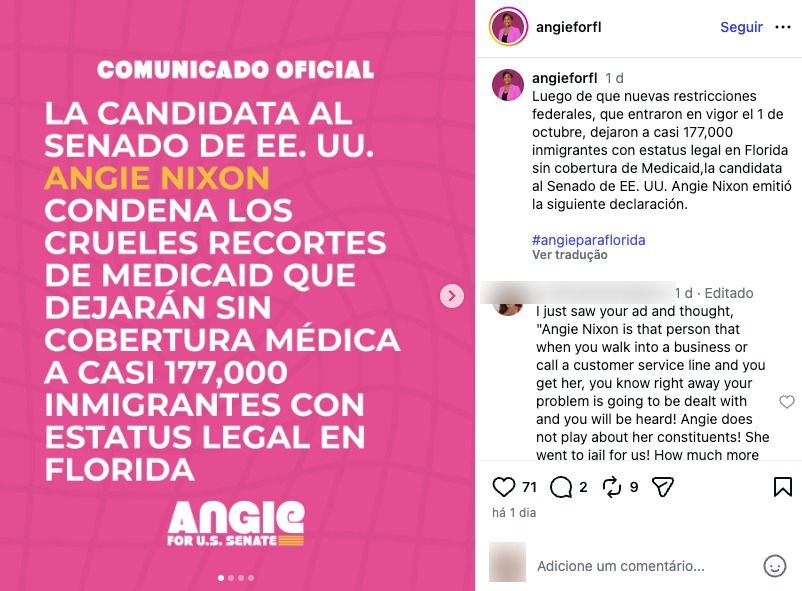
That progression is particularly potent in Florida. For decades, Republicans have used warnings about socialism and communism to mobilize Latino voters, particularly communities with roots in Cuba, Venezuela and Nicaragua. Nixon is now confronting the durability and the limits of that strategy firsthand.
Race and gender
Vance did not explicitly invoke Nixon’s race or gender. His stated objection was ideological. But the candidate he told to “get the hell out” of the country is a Black American woman whose grandparents were sharecroppers in southern Georgia.
That makes the rhetoric more consequential than a conventional argument over taxes, health care or the size of government. Vance warped the concept of freedom of expression and standing for your own ideas, core tenets of American democracy, and argued that Nixon’s ideas belonged outside the boundaries of America. This is a thought-terminating, emotional message of belonging that takes people away from considering the nuance, complexities, or even the core of what the candidate is proposing.
That message on social media is, as is common, now mixing with ideological hostility that intersects with racism and misogyny. That is a dynamic DDIA will continue to monitor as the campaign unfolds.